



TL;DR: AI music disclosure is becoming part of music distribution, but there is no single universal rule. Industry bodies have proposed separate labels for AI generated and AI assisted recordings. Some distributors now request broader disclosures. EU transparency law also applies in certain situations, especially when synthetic media could be mistaken for an authentic person or event. Artists and labels should document how every release asset was created, answer distributor questions precisely, and review voice imitation and other deepfake risks before release.
AI music disclosure is no longer a future proposal.
During July and early August 2026, music industry bodies, distributors, streaming services, and EU regulators all moved toward clearer disclosure of artificial intelligence.
The RIAA, IFPI, A2IM, WIN, IMPALA, The Grammys, SAG AFTRA, and the Human Artistry Campaign announced common labels for AI generated and AI assisted recordings. Catapult introduced mandatory AI disclosure questions during music delivery. Article 50 of the EU AI Act started applying on 2 August.
These developments are connected. They are not interchangeable.
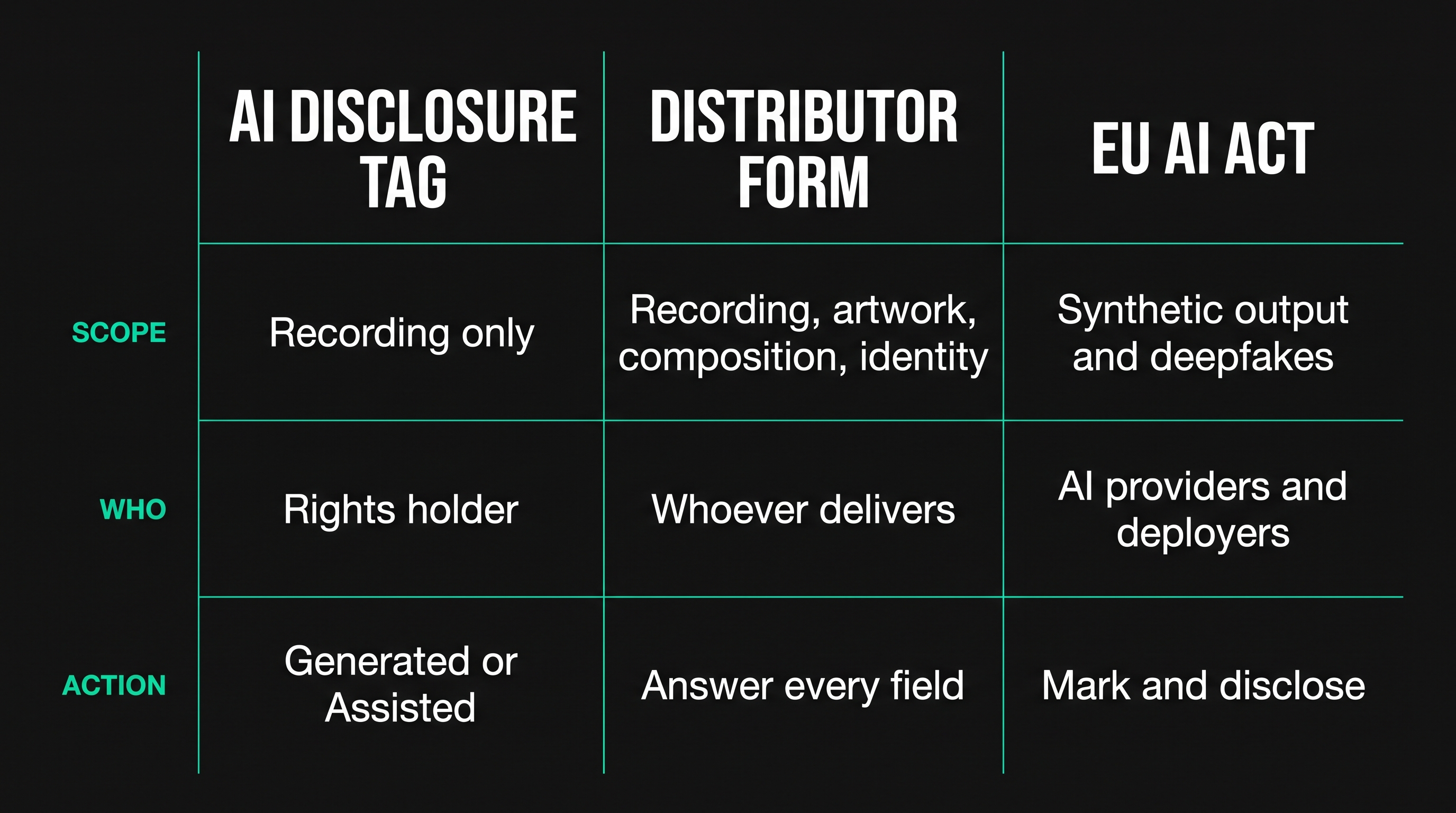
An industry AI disclosure label can cover the sound recording. A distributor may ask separate questions about the composition, artwork, and artist identity. EU law focuses on the responsibilities of AI system providers and professional deployers, including disclosure of deepfakes in certain situations.
Artists and labels need to know which system is asking the question before deciding how to answer it.
The music industry is moving toward AI disclosure without agreeing on one definition, one scope, or one delivery process.
Why AI Music Disclosure Is Becoming Standard
The volume of synthetic music entering streaming catalogs has accelerated.
In July, Deezer reported that it was receiving about 90,000 fully AI generated tracks each day. These tracks exceeded 50 percent of new uploads at peak times during June 2026.
That does not mean AI music accounts for half of listening. According to Deezer, fully AI generated tracks represented only 1 to 3 percent of streams on its service. Deezer also said that up to 85 percent of streams on fully AI generated tracks were identified as fraudulent during 2025.
These are Deezer figures, not an estimate for the entire streaming market. They still show why disclosure has become urgent.
Streaming services must distinguish between creative use of AI, deceptive imitation, automated catalog flooding, and stream manipulation. Those are different activities. A single AI flag cannot explain all of them.
The current response is a layered system of labels, metadata, detection, and platform policy.
What AI Generated and AI Assisted Mean
The clearest industry definitions currently come from the voluntary labeling framework announced by major music organizations in July 2026.
AI generated: Generative AI created the entirety or the primary portion of the expressive elements in the recording. The proposed definition includes a generated lead vocal, a generated key instrumental performance, or music created primarily from a prompt.
AI assisted: Humans created most of the recording and generative AI contributed some expressive elements. Under the proposed definition, humans still perform the lead vocal and primary instruments.
The distinction is based on the role AI played in the recording. It is not based on whether an artist opened an AI tool at any point during production.
Routine processing should not automatically place a recording in the same category as a generated vocal or instrumental performance. Noise reduction, file restoration, and standard editing do not replace the primary creative performance in the same way.
The industry announcement also sets an important boundary. Its proposed track labels currently cover generative AI in sound recordings. They do not cover lyrics, composition, music videos, or cover art.
That boundary is one reason artists cannot treat every AI disclosure question as the same question.
Three Different Disclosure Systems
Industry AI Disclosure Labels
The proposed industry standard distinguishes AI generated recordings from AI assisted recordings.
The program is voluntary. It is designed for broad adoption by streaming services, distributors, aggregators, and standards bodies. The label would be supported by recording metadata and displayed at track level.
This framework gives fans a simple explanation of how AI contributed to the recording. It does not create a complete record of every AI tool used across the release.
Distributor Metadata
Distributors decide what information they collect before delivering a release to streaming services.
On 27 July, Catapult said it had introduced mandatory disclosure fields for cover art, sound recordings, composition information, and artist identity. Artists and labels using the service must answer whether AI generated or substantially assisted each element.
The scope is broader than the proposed industry AI disclosure labels. Cover art and composition are outside the current AI disclosure label framework, but they are included in Catapult’s submission process.
Other distributors may ask different questions or use different definitions. The wording of the delivery form matters.
EU AI Act Transparency Rules
Article 50 of the EU AI Act started applying on 2 August 2026.
The rules separate AI system providers from deployers. Providers develop an AI system or place it on the EU market under their name. Deployers use an AI system professionally under their authority.
Providers of generative AI systems must generally make synthetic audio, image, video, and text outputs detectable through machine readable marking. Certain exceptions apply, including some standard editing functions.
The Commission provides a limited transition period for the marking obligation. Providers of systems placed on the market before 2 August 2026 have until 2 December 2026 to meet that specific requirement.
Professional deployers must clearly disclose deepfake content. The European Commission defines a deepfake as AI generated or manipulated image, audio, or video that resembles an existing person, object, place, entity, or event and falsely appears authentic or truthful.
For music teams, synthetic voice imitation is the most obvious area that needs careful review. A generated vocal that closely resembles a real performer can raise different questions from a clearly fictional synthetic instrument.
Creative and artistic works are not ignored by the law. The disclosure can be made in an appropriate way that does not interfere with the normal display or enjoyment of the work.
Legal note: This is a practical summary, not legal advice. Teams releasing synthetic vocals or other realistic imitations should obtain advice based on the release, territory, rights, and intended use.
Does the EU AI Act Require Every AI Song to Carry a Label?
No.
Article 50 does not state that every commercially released song involving AI must carry a visible listener label.
The marking obligation for synthetic outputs falls primarily on providers of generative AI systems. The visible disclosure duty for professional deployers focuses on deepfakes and certain AI generated text about matters of public interest.
An AI generated audio file is not automatically a deepfake. The content must resemble an existing person, object, place, entity, or event and falsely appear authentic or truthful.
This distinction matters for music.
A fictional generated instrument does not present the same disclosure issue as a vocal designed to sound like a named living artist. An obviously synthetic creative work does not create the same audience expectation as a recording presented as a genuine performance by a real person.
The industry labeling program may still classify the recording as AI generated even when the legal deepfake definition does not apply. A distributor may also request disclosure through its own delivery form.
That is why compliance with one system does not automatically answer the other two.
What Artists and Labels Should Do Before Release
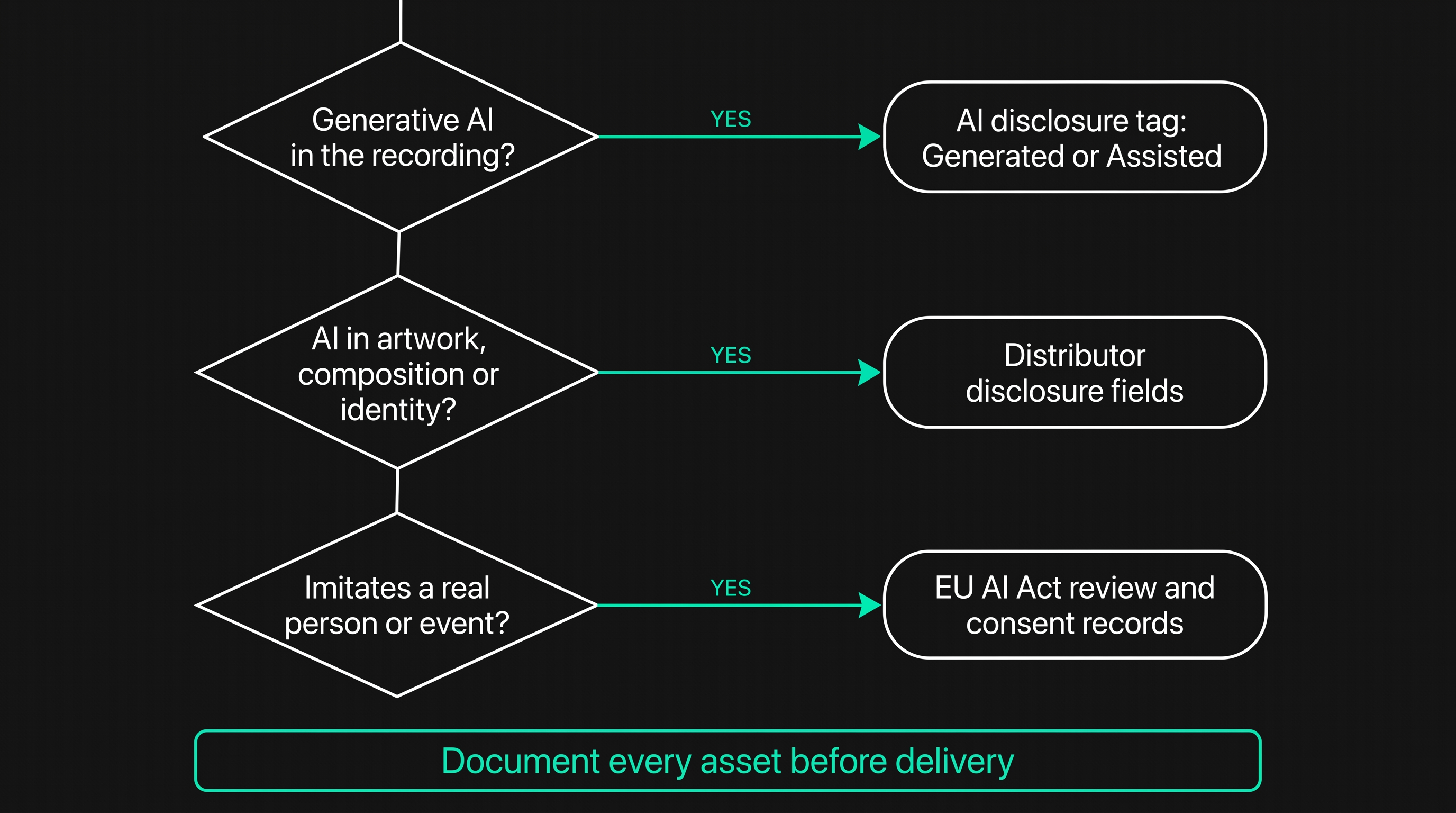
1. Record Every Material Use of AI
Create an internal record for each asset.
Include the tool used, the output created, the human contribution, the release asset affected, and the date. Keep source files and project files where possible.
This record makes distributor forms easier to complete and gives the team evidence if a platform questions the release later.
2. Separate Processing From Expressive Generation
Do not group every AI function together.
Standard editing, restoration, transcription, generated artwork, generated instruments, and synthetic vocals affect different parts of a release. They may also receive different treatment under an industry standard, a distributor policy, or law.
3. Review Voice and Identity Imitation
Ask whether a reasonable listener could believe that the audio features a real performer who did not participate.
Document consent and rights where a real identity, voice, likeness, or performance is involved. Do not assume that a general AI disclosure resolves an unauthorized imitation.
4. Read the Exact Distributor Question
Answer the field being presented.
A question about the sound recording is not a question about the composition. A question about generated content may not have the same scope as a question about substantial assistance.
If the wording is unclear, request written guidance from the distributor before delivery.
5. Audit Every Release Asset
Review the recording, composition, artwork, videos, visualizers, social media clips, press copy, and artist identity separately.
One release can contain several different AI use cases. One answer should not be copied across every asset without review.
6. Preserve Rights and Consent Records
Keep licenses, performer approvals, model releases, source documentation, and relevant contracts with the release file.
Disclosure tells an audience that AI was used. It does not prove that the team had permission to use a protected work, performance, voice, or likeness.
7. Monitor Policy Changes
The industry labels are intended to evolve. Distributor requirements and streaming policies will also change.
Assign responsibility for reviewing delivery rules before each release. Do not assume the answer used six months ago is still sufficient.
What This Means for Music Marketing
AI disclosure is becoming part of release operations. It will also influence how artists build trust.
The value of raw content volume is falling. A catalog can contain more tracks without producing more meaningful listening. Deezer’s figures show the difference clearly. Synthetic music exceeded half of new uploads at peak times, but represented only a small share of actual streams.
Labels and managers should apply the same distinction to campaign reporting.
Views, clicks, uploads, and surface level stream counts do not explain whether promotion created real listener behavior. Teams need to know whether listeners played the track, saved it, followed the artist, or returned later.
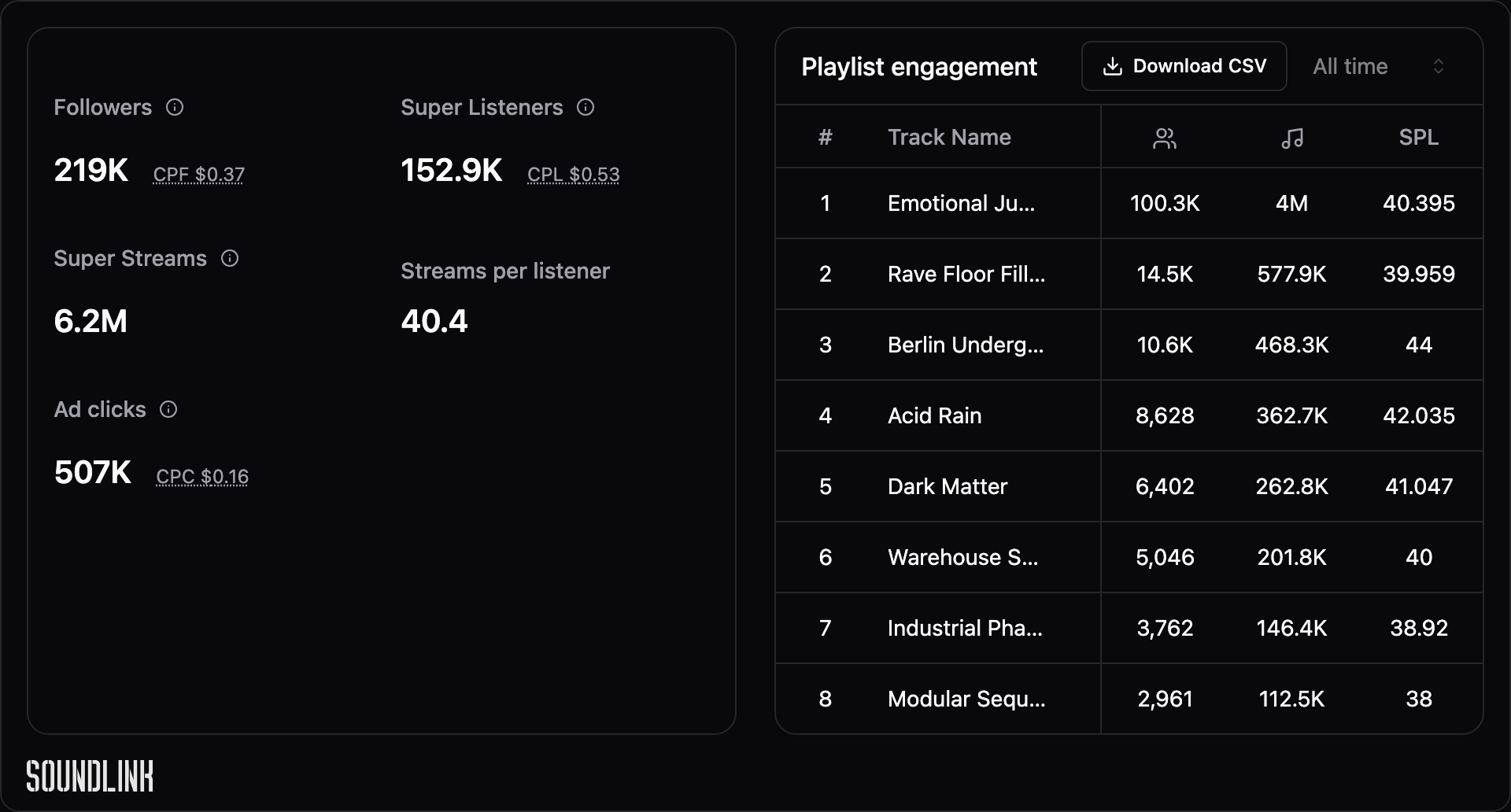
Soundlink’s paid campaigns report outcomes including cost per listener, cost per follower, and cost per save alongside campaign spend. This gives labels and managers a clearer view of whether promotion is producing genuine fan actions.
Soundlink does not determine whether a recording is AI generated. That is a separate disclosure problem. Its role is to help teams measure whether marketing campaigns produce real engagement after the ad reaches listeners.
What Is Still Unresolved
There is no universal public label across every streaming service.
The proposed industry standard still requires implementation by distributors, metadata systems, and digital music services. Its current scope excludes composition, lyrics, videos, and artwork.
Distributor forms can collect more information than listeners eventually see. Platform policies can also change what happens after delivery, including recommendation eligibility, monetization, or removal.
The EU AI Act adds another layer, but it is not a substitute for platform rules, recording agreements, copyright law, performer consent, or distributor policy.
Teams should expect the system to remain fragmented while standards develop.
Frequently Asked Questions
What Is an AI Music Label?
An AI music label tells listeners or music services how generative AI contributed to a recording. The industry framework announced in July 2026 proposes separate labels for AI generated and AI assisted recordings.
What Is the Difference Between AI Generated and AI Assisted Music?
AI generated music uses generative AI for the entirety or primary portion of the expressive elements in the recording. AI assisted music remains substantially human created, with generative AI contributing some expressive elements.
Does the EU AI Act Require All AI Music to Be Labeled?
No. Article 50 places machine readable marking obligations on providers of certain generative AI systems. Professional deployers must visibly disclose deepfakes in relevant situations. Not every AI generated audio file meets the legal definition of a deepfake.
Does AI Cover Art Need to Be Disclosed?
The proposed industry AI disclosure labels do not currently cover artwork. A distributor may still ask about it. Catapult, for example, now includes AI disclosure questions for cover art in its submission process.
Does AI Mastering Make a Track AI Assisted?
Not necessarily. The proposed AI disclosure labels focus on generative AI used for expressive elements. Standard processing or editing is different from generating a lead vocal or key instrumental performance. Artists should still read the exact definition used by their distributor.
Is an AI Label the Same as Permission?
No. Disclosure does not grant rights to use another person’s composition, recording, performance, voice, likeness, or identity. Rights and consent must be handled separately.
Transparency Is Becoming Part of Music Distribution
There is no single AI music label that resolves every question.
The industry AI disclosure labels explain how generative AI contributed to a recording. Distributor metadata can cover a wider set of release assets. EU law creates separate responsibilities for AI system providers and professional deployers.
Artists and labels do not need one blanket answer. They need a reliable release record and a precise answer for each system.
The standard will keep changing. The operating habit is already clear. Know how every asset was made, know whose rights it touches, and disclose it in the place that actually asks.