


Music marketers trying to learn how to train the Spotify algorithm usually focus on saves, repeat plays, and release velocity. They rarely ask where those listener signals should come from.
That leaves one of the strongest paid promotion opportunities underused.
Tier 2 and Tier 3 countries can produce substantially more Spotify listeners for the same Meta ads budget than Tier 1 countries. When those listeners are relevant and engaged, they give Spotify more evidence about who the track is for.
This is not a royalty return strategy. It is an algorithmic return strategy.
TL;DR
Tier 2 and Tier 3 campaigns can improve Spotify algorithm training ROI because lower listener acquisition costs allow the same budget to generate more saves, follows, repeat plays, playlist additions, and catalog activity.
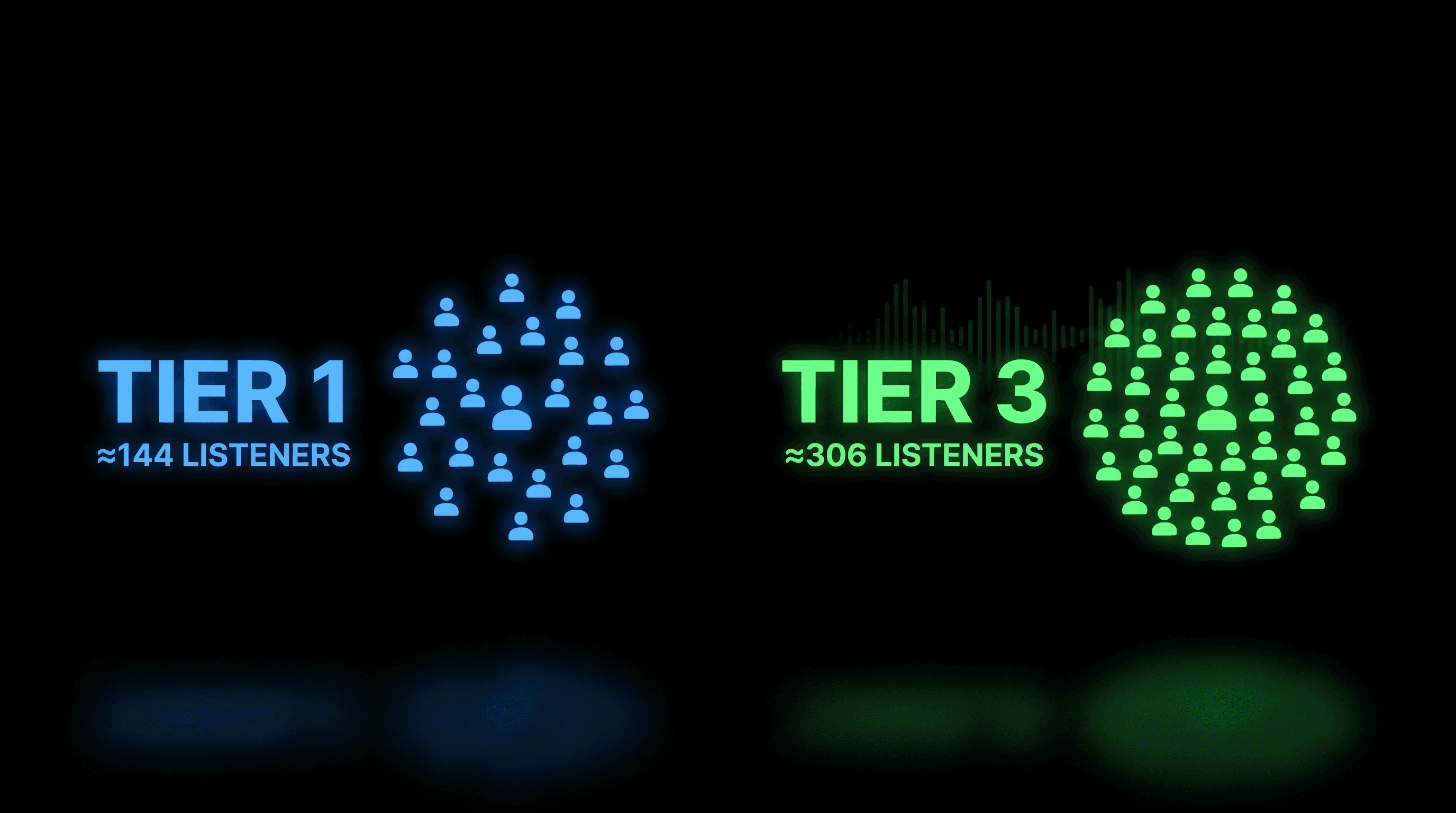
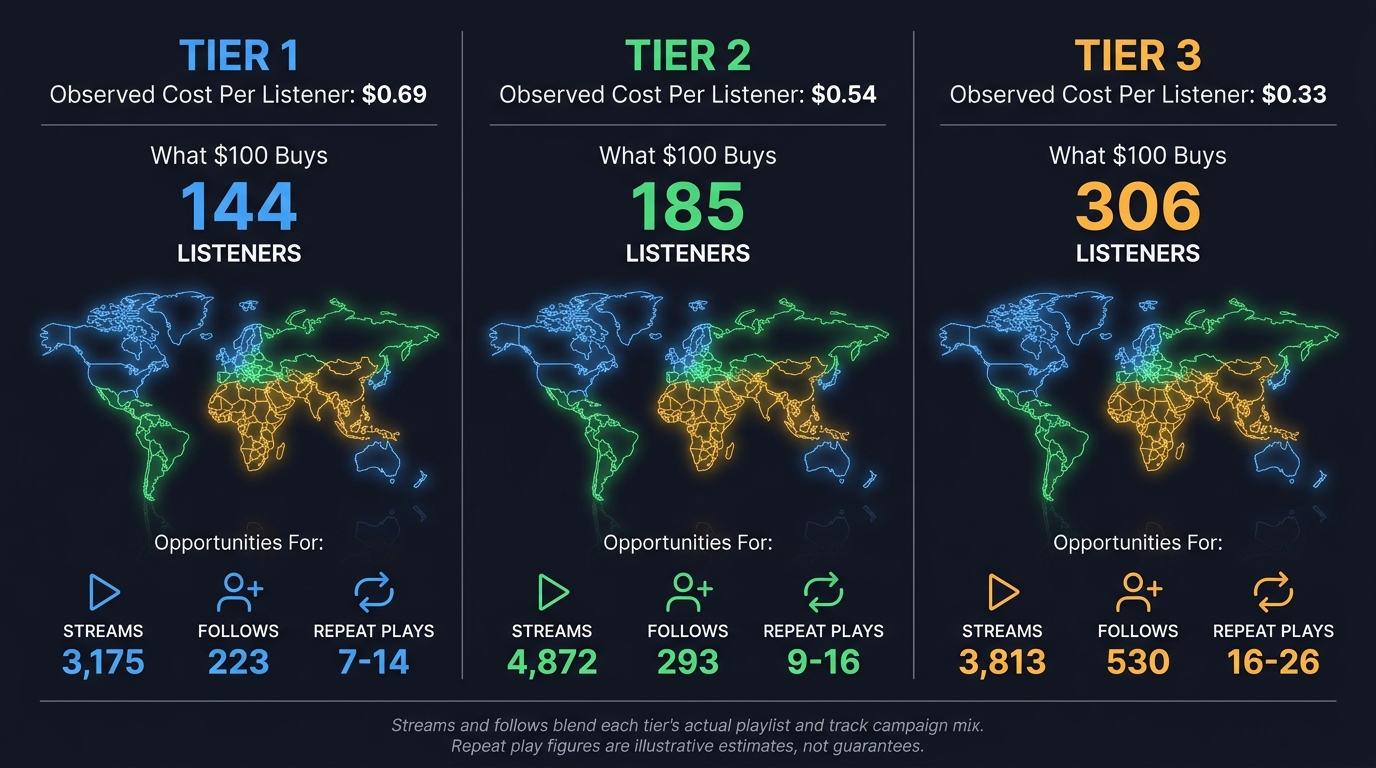
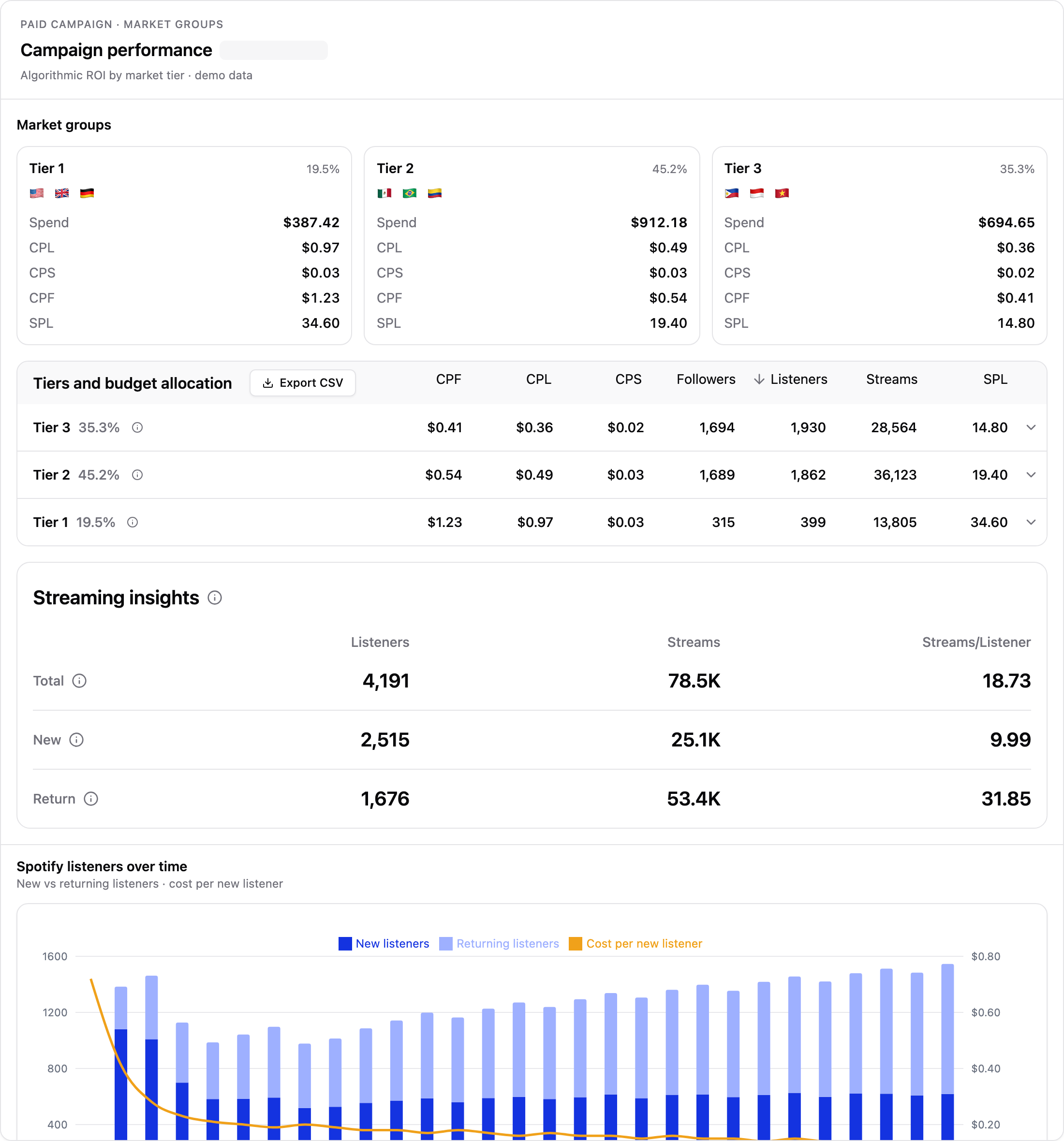
Soundlink campaign data reports an observed average cost per new listener of $0.69 in Tier 1, $0.54 in Tier 2, and $0.33 in Tier 3. At those observed rates, a $100 budget would acquire about 144 Tier 1 listeners, 185 Tier 2 listeners, or 306 Tier 3 listeners.
Those figures do not mean Spotify values one country more than another. Spotify has not confirmed a country based recommendation bonus. The advantage is more opportunities to generate relevant listener behavior for the same spend.
The strategy works only when the campaign produces quality adjusted signal volume. Cheap listeners who skip, never save, and never return do not train Spotify toward a useful audience.
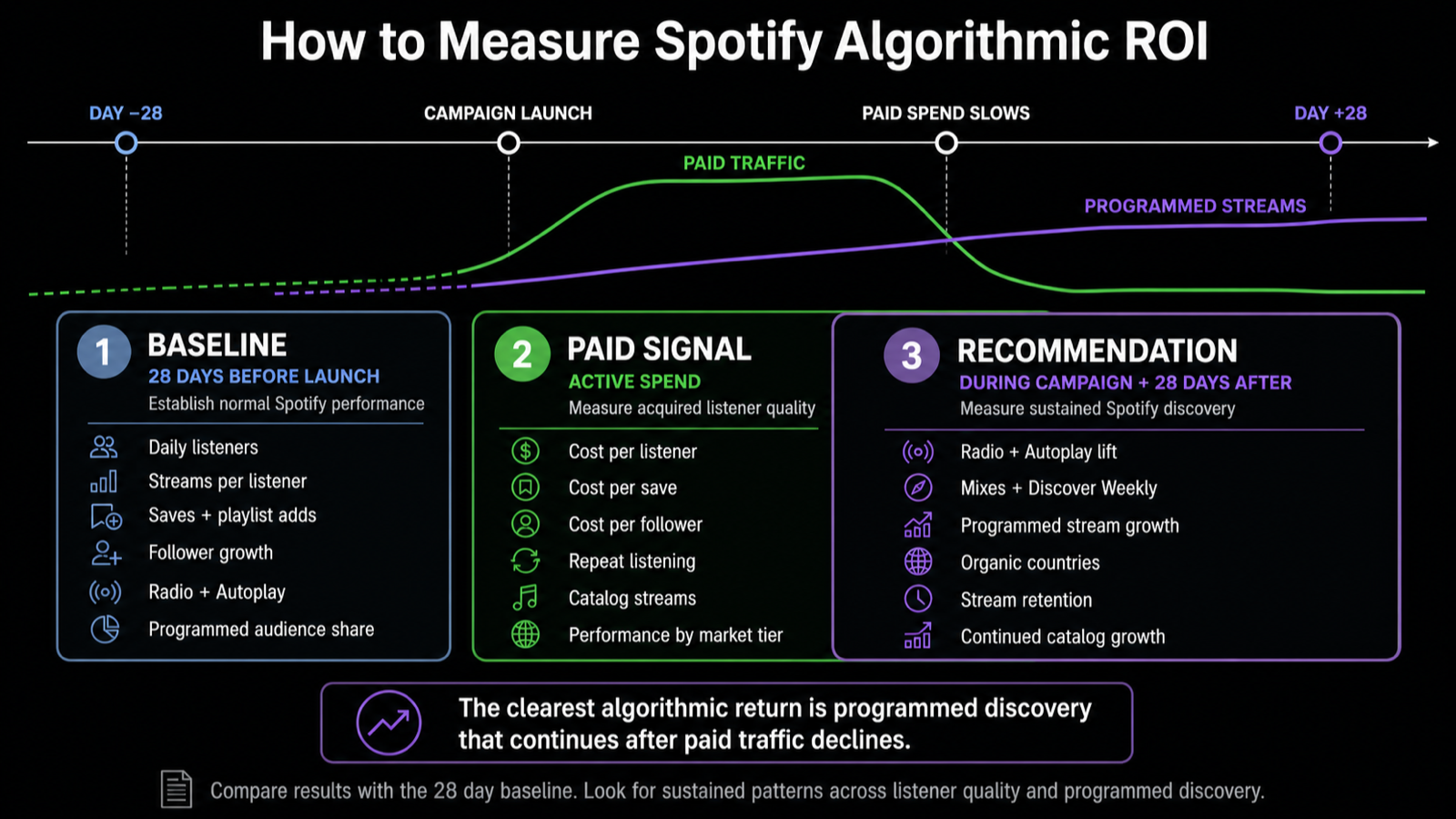
The algorithmic return is not the stream you bought. It is the organic discovery that continues after paid traffic slows down.
What Spotify algorithm training actually means
An advertiser cannot directly train or configure Spotify’s recommendation systems.
Paid social does not send Meta campaign data, budget data, or country tier labels into Spotify. Spotify sees what happens when listeners arrive.
Spotify explains that personalized playlists consider what people listen to, when they listen, which songs they add to playlists, and the behavior of other listeners with similar tastes.
Training is therefore a useful marketing shorthand for supplying Spotify with consistent listener evidence:
-
The kinds of listeners who choose the track
-
The other music those listeners enjoy
-
Whether they complete or skip the track
-
Whether they save it or add it to a playlist
-
Whether they return to the song
-
Whether they explore the artist’s catalog
Spotify has also described full listens, skips, playlist additions, artist engagement, popularity, and the behavior of other users as inputs that can shape recommendations.
When those patterns are coherent, Spotify has more information for matching the track to potential listeners in Radio, Autoplay, Mixes, Discover Weekly, and other personalized surfaces.
When the patterns are weak or scattered, more stream volume does not necessarily improve the match.
What algorithmic ROI should measure
Normal return on ad spend asks how much revenue a campaign generated.
Algorithmic ROI asks how much useful Spotify discovery the campaign created beyond the listeners acquired directly.
This is not an official Spotify metric. It is a campaign evaluation framework.
The return should be measured through two groups of signals.
Leading signals
Leading signals show whether the paid audience is giving Spotify useful information:
-
Cost per listener: The price of each actual acquired Spotify listener.
-
Cost per stream: The price of a strong intent action.
-
Cost per follower: The price of an ongoing artist connection.
-
Streams per listener: Whether the audience returns to the track.
-
Playlist additions: Whether listeners want the track in their own listening environment.
-
Catalog activity: Whether the campaign creates interest beyond one song.
Lagging signals
Lagging signals show whether Spotify began expanding distribution:
-
Growth in Radio and Autoplay streams
-
Growth in Mixes and other personalized playlists
-
New Discover Weekly activity
-
Higher programmed audience share
-
Continued daily streams after paid spend slows
-
New organic listeners in countries that were not directly targeted
Spotify’s Discovery Mode reporting uses a similar distinction. It separates audience growth, streams, and longer term engagement actions such as saves, playlist additions, and intent rate.
The measurement principle is simple. Paid listener volume is the input. Sustained programmed discovery is the return.
Why country tiers change algorithmic ROI
Algorithmic learning needs listener behavior. Paid promotion buys opportunities for that behavior to occur.
The number of opportunities depends partly on cost per listener.
Soundlink’s music marketing guide publishes these observed campaign averages:
-
Tier 1: $0.69 per listener
-
Tier 2: $0.54 per listener
-
Tier 3: $0.33 per listener
These are Soundlink observations, not universal industry benchmarks. Actual costs change by genre, language, creative, market, and campaign setup.
The strategic difference is still significant.
At the reported averages, Tier 2 produces about 28 percent more acquired listeners than Tier 1 for the same spend. Tier 3 produces a little over twice as many.
Each additional relevant listener is another opportunity for Spotify to observe a completion, save, follow, repeat play, playlist addition, or catalog visit.
Tier 2 and Tier 3 campaigns can therefore generate more recommendation evidence per budget even when their immediate royalty return is lower.
Premium markets can produce more revenue value per listener. Growth markets can produce more learning value per advertising dollar.
Spotify learns from patterns
The country itself is not the training signal.
Spotify says its personalization combines multiple algorithms, editorial input, and data curation. It aims to match each listener with content they are likely to enjoy.
The useful signal is the relationship between a track and the people who respond to it.
If a cluster of electronic music listeners in Mexico saves a track, repeats it, and explores the artist’s catalog, Spotify gains information about the track’s audience fit.
If a cluster of indie listeners in the Philippines does the same, that behavior can provide another coherent audience pattern.
If a broad campaign brings isolated clicks from unrelated listeners across many countries, the volume may be less useful. Spotify receives activity without a clear picture of who should hear the track next.
This is why lower cost targeting must remain genre matched and culturally credible.
Quality adjusted signal volume is the real advantage
The case for Tier 2 and Tier 3 countries is often reduced to cheap streams.
That is the wrong argument.
The useful advantage is quality adjusted signal volume. This means the total number of meaningful listener actions a budget generates after accounting for audience fit.
Consider two campaigns.
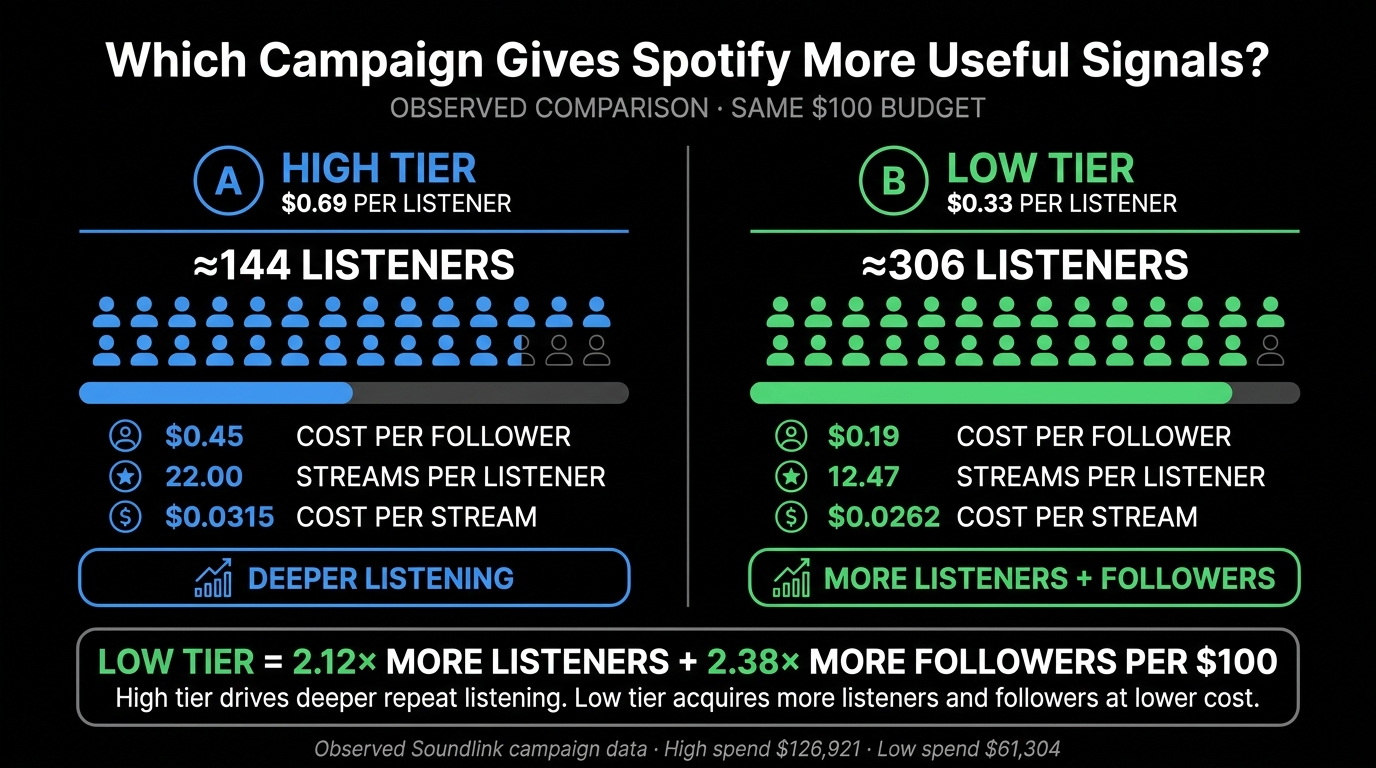
Campaign A reaches fewer listeners in a premium market. Those listeners show strong save and repeat behavior.
Campaign B reaches over twice as many listeners in a scale market. Each individual listener engages at a lower rate, but the campaign still produces more total saves, follows, and repeat plays.
Campaign B may create the stronger algorithmic return even though its royalty value is lower.
The opposite can also happen. If the scale audience generates cheap clicks but poor Spotify behavior, the additional volume is not useful. Campaign A wins because its smaller audience produces clearer evidence of fit.
The correct comparison is not Tier 1 quality against Tier 3 cost. It is the total number of meaningful Spotify engagement actions produced by each market group.
Why the strategy is overlooked
Music marketers are usually taught to prioritize Tier 1 countries for three reasons:
-
Higher royalty value
-
Stronger touring and merchandise potential
-
Familiar industry markets such as the United States, United Kingdom, Germany, Canada, and Australia
Those are valid commercial goals. They are not the same as recommendation training.
An algorithmic campaign is trying to help Spotify identify a plausible audience and gather enough listener behavior to test the track more widely. Paying premium market acquisition costs for every training listener can limit the amount of evidence a small budget produces.
Community discussions show the resulting split. Some artists argue that lower tier countries damage recommendation quality. Others report Radio, Autoplay, and Discover Weekly growth after running campaigns in Latin America or Southeast Asia.
Neither anecdote proves a universal rule.
The missing variable is what those listeners did after arriving on Spotify.
The spillover effect and what the data can support
The ideal algorithmic return appears when paid activity in one group of countries is followed by organic listening elsewhere.
Soundlink’s marketing bible reports that 15 to 30 percent of total streams in some campaigns arrived organically from Tier 1 markets after Tier 3 promotion.
This is an observed Soundlink campaign pattern. It is not a controlled experiment, a guaranteed result, or proof that Spotify gives Tier 3 activity special weight.
The result is consistent with a defensible sequence:
-
Paid ads acquire real listeners at a lower cost.
-
Relevant listeners complete, save, follow, repeat, or explore.
-
Spotify gains more evidence about the track and its likely audience.
-
Personalized systems may test the track with similar listeners.
-
Successful tests may expand into new markets and recommendation surfaces.
Spotify confirms the role of listener behavior in personalization. It does not publish a guaranteed trigger point for this sequence.
Soundlink’s analysis of Spotify Discover Weekly reaches the same conclusion. Popularity scores and stream volume reflect momentum. They are not confirmed switches for recommendation placement.
Which lower cost regions create useful training opportunities
Country selection should start with audience fit, not a universal tier list.
Latin America
Mexico, Argentina, Chile, Colombia, Peru, and Brazil offer large and active music audiences. Spanish language countries should be separated from Brazil when the creative contains text.
Latin America is relevant beyond Latin genres. Pop, electronic, indie, rock, alternative, and instrumental releases can all find credible audiences when the creative and artist positioning fit.
Southeast Asia
Indonesia, the Philippines, Thailand, Malaysia, and Vietnam can provide efficient audience testing for pop, electronic, alternative, and instrumental releases.
Spotify reported that Filipino music streams quadrupled globally over five years. That does not guarantee demand for every international release. It does demonstrate active music discovery and cross border listening.
North Africa
North Africa requires controlled country tests rather than one broad regional group.
Spotify has invested in Arabic language products, local editorial teams, playlists, and artist programs. In 2025, Spotify described the Middle East and North Africa as the fastest growing recorded music region.
Arabic music, French language music, hip hop, electronic music, Afrobeats, and instrumental genres may each produce different audience clusters across Egypt, Morocco, Algeria, and Tunisia.
How to structure a campaign for Spotify algorithm training
The campaign should be designed to answer one question.
Which audience produces the most useful Spotify behavior for the available budget?
1. Establish a baseline
Record the previous 28 days of Spotify for Artists data before the campaign begins.
Track total listeners, streams per listener, saves, playlist additions, follower growth, catalog activity, and source of streams.
2. Separate country tiers
Do not place every market in one ad set when comparing algorithmic value. Meta may direct most spend to the cheapest selected result.
Separate premium, growth, and scale groups. Split language groups when the creative needs localization.
3. Keep the audience hypothesis coherent
Target listeners whose existing tastes match the track. Avoid expanding into a market only because clicks are cheap.
The campaign should help Spotify identify an audience pattern, not generate unrelated activity.
4. Optimize for a meaningful action
Meta says campaign objectives guide its system toward people likely to complete the selected action. Traffic optimization finds visits. A properly configured conversion objective can find people more likely to complete the defined conversion.
The conversion path must still be evaluated against Spotify side behavior.
5. Localize the creative
Translate captions and on screen context. Adapt cultural references. Use a music excerpt that communicates the genre immediately.
Localization increases the chance that the acquired listener is genuinely relevant.
6. Measure the paid signal phase
Compare market groups on cost per listener, cost per save, cost per follower, streams per listener, and catalog activity.
Pause audiences that generate low cost traffic without meaningful Spotify actions.
7. Measure the recommendation phase
Watch Radio, Autoplay, Mixes, Discover Weekly, and programmed audience activity during the campaign and after spend slows.
Compare those changes with the 28 day baseline. Continue observing for at least one full Spotify for Artists reporting cycle after the campaign.
The Spotify algorithm training scorecard
A strong market group should improve both acquisition efficiency and listener behavior.
Use the following scorecard.
Paid audience efficiency
-
Cost per listener
-
Cost per full stream
-
Cost per follower
Listener quality
-
Streams per listener
-
Playlist additions
-
Catalog streams
-
Returning listener activity
Algorithmic return
-
Change in programmed streams
-
Change in Radio and Autoplay
-
Change in personalized playlist activity
-
Organic listening outside targeted countries
-
Daily stream retention after paid traffic slows
No single metric proves that a campaign trained Spotify. The combined pattern shows whether paid acquisition created lasting discovery.
Spotify also distinguishes between active and programmed audiences. Its audience segment guidance states that listeners who actively choose an artist play that artist four times more on average during the following six months than other listeners.
That is why active behavior should carry more weight than raw stream volume in the scorecard.
How Soundlink measures algorithmic return by market
Meta can report impressions, clicks, and conversion events. Spotify for Artists can report total listeners and sources of streams. Neither dashboard automatically shows which ad set acquired the listeners who later saved, followed, or returned.
Soundlink’s paid campaigns connect ad spend with Spotify side outcomes. Labels, managers, agencies, and artists can compare cost per listener, cost per save, and cost per follower across campaign segments.
That makes Tier 2 and Tier 3 testing measurable.
A lower cost market earns more budget when it produces real Spotify listeners and strong downstream behavior. It does not earn more budget merely because it delivers cheap landing page results.
Soundlink’s reporting also helps teams compare the paid signal phase with later Spotify activity. The mechanism remains private. The outcome is clear: market decisions can be made against Spotify listener behavior rather than ad platform proxies.
Frequently Asked Questions
Can Meta ads train the Spotify algorithm?
Meta ads do not communicate ad spend or targeting data directly to Spotify. They can bring relevant listeners whose behavior gives Spotify more information about the track and its audience.
Why use Tier 2 and Tier 3 countries for algorithm training?
Lower acquisition costs can produce more real listeners for the same budget. This creates more opportunities for saves, follows, repeat plays, playlist additions, and catalog discovery.
Does Spotify value a Tier 1 stream more in its algorithm?
Spotify has not published evidence that recommendation weight is assigned by country tier. Royalty value can vary by market, but recommendation systems are described in terms of listener behavior, taste, context, and similar audience patterns.
Can cheap streams hurt a Spotify release?
Low intent traffic can produce weak behavior such as early exits, no saves, and no repeat listening. The problem is not the country’s tier. It is the mismatch between the audience and the track.
Which metrics show that algorithm training is working?
Look for rising streams per listener, saves, playlist additions, followers, catalog activity, and programmed streams. Growth in Radio, Autoplay, Mixes, and Discover Weekly after paid acquisition begins is a stronger sign than total streams alone.
How long should algorithmic return be measured?
Establish a 28 day baseline before the campaign. Measure throughout active spend and continue after spend slows so paid traffic can be separated from sustained programmed discovery.
Should Tier 1, Tier 2, and Tier 3 countries share one ad set?
Not when the objective is comparison. Separate ad sets prevent lower cost countries from absorbing the budget and allow listener quality to be evaluated by market group.
Is algorithmic ROI more important than royalty ROI?
That depends on the campaign goal. Artist development campaigns may prioritize sustainable discovery. Catalog monetization campaigns may prioritize revenue. The two returns should be measured separately.
More useful signals create more chances for discovery
Tier 2 and Tier 3 targeting is overlooked because most country strategies begin with royalty rates and touring value.
Spotify recommendation training requires a different calculation.
The campaign needs relevant listeners, enough behavior to reveal a pattern, and measurement that shows whether paid acquisition led to programmed discovery.
Lower cost markets can create that evidence faster and at greater scale. They outperform premium markets when the total volume of meaningful actions is higher, even if each stream produces less direct revenue.
The best training market is not the country with the cheapest click. It is the market that produces the most useful Spotify listener behavior and the strongest organic discovery after the paid campaign has done its job.