



A growing number of artists and label teams are trying to engineer Spotify Discover Weekly placement by targeting specific popularity scores, manipulating stream velocity, or scaling Meta ad budgets based on gut feel. A recent Reddit case study gives the music marketing industry rare, specific numbers from a track that did reach Discover Weekly. The data is worth reading carefully, because the wrong takeaway is as common as the right one.
TL;DR: Spotify Discover Weekly is not triggered by hitting a specific popularity score. Artist reported case study data shows tracks with high repeat listening, coherent audience fit, and strong engagement signals are more likely to receive algorithmic testing. Popularity score reflects listener momentum but is an outcome, not a confirmed input. The marketing goal is building signal quality, not stream volume.
A Reddit Case Study and What the Numbers Show
A thread posted in r/musicmarketing documented a song’s placement on Spotify Discover Weekly. The artist shared Spotify for Artists data from the point of placement, giving a specific picture of the conditions under which an algorithmic test appeared to trigger.
The reported metrics at the time of Discover Weekly placement:
| Metric | Artist reported value |
|---|---|
| Release date | April 17, 2026 |
| Total streams | 15,141 |
| Monthly listeners | 3,589 |
| Monthly active listeners | 1,900 |
| Song streams per listener | 3.6 |
| Artist streams per listener | 3.8 |
| Track popularity score | 31 |
| Artist popularity score | 13 |
| Spotify followers | 211 |
| Genre | Alt/indie rock |
| Discover Weekly streams on spike day | 256 |
| Total streams on spike day | 718 |
All figures above are artist reported via Reddit and have not been independently verified.
The artist noted their track appeared to receive Discover Weekly placement when its popularity score was around 31. A commenter in the thread suggested increasing daily ad spend velocity might help Spotify perceive a track as rising in popularity. That commenter explicitly framed it as speculation.
The community framework building around threads like this follows a sequential model: Meta ads drive real Spotify listeners → repeat listening behavior raises popularity score → Spotify runs algorithmic tests → Discover Weekly and Radio placements follow.
That sequence is not confirmed by Spotify. But the data points to the right variables even if the mechanism between them is not fully understood.
What Spotify Confirms About Discover Weekly
Spotify classifies Discover Weekly as an algorithmic, personalized playlist that updates every Monday with 30 tracks personalized per listener. Its documentation describes Discover Weekly, Release Radar, Daily Mix, Radio, Autoplay, Mixes, and personalized editorial playlists as recommendation surfaces that use multiple signals to connect tracks to listeners.
Several points are confirmed in Spotify’s own materials.
Personalized recommendations drive significant discovery. Spotify states that 33% of all new artist discoveries happen through personalized sessions including Discover Weekly, Radio and Autoplay, Mixes, and personalized editorial playlists.
There is no confirmed formula for placement. Spotify’s documentation states directly that “there is nothing specific you can do to get on an algotorial playlist.” Release Radar eligibility lasts up to 28 days after release, but Discover Weekly is not a release window surface.
Spotify surfaces engagement alongside stream data. Spotify for Artists shows source of stream data alongside streams per listener, saves, and playlist adds. These are not confirmed as direct ranking factors, but Spotify treats them as diagnostically meaningful.
What Spotify does not confirm: any fixed popularity score threshold, any relationship between ad spend velocity and algorithmic placement, or any guaranteed path to Discover Weekly.
The Popularity Score Trap
Spotify’s Web API defines track popularity as a value from 0 to 100. It is calculated algorithmically and based primarily on total plays and how recent those plays are. Tracks receiving active plays now rank higher than tracks with high lifetime streams that are no longer being played. The value can lag a few days behind actual listening activity.
The Reddit case reported a track popularity score of 31 at the time of Discover Weekly placement. That has produced a community assumption that score 30 is a threshold.
There are three ways to read this.
Weak interpretation: A popularity score of 30 triggers Discover Weekly. Spotify’s documentation does not support this. It should not be presented as confirmed.
Better interpretation: A popularity score around 30 may reflect enough recent listening activity for Spotify to have usable data about who the track is for.
Strongest interpretation: Popularity score is an outcome signal, not a confirmed input. The same listener behavior that raises the score simultaneously provides cleaner recommendation signals. The score does not cause the placement.
Third-party research from Music Tomorrow, based on a dataset of over 500,000 tracks, found no meaningful relationship between track popularity and relative algorithmic exposure. Their conclusion: what mattered was not track size but the quality, coherence, and contextual consistency of the listening signals.
Chasing a popularity score is optimizing for a proxy. The actual target is giving Spotify’s recommendation system coherent listener data.
What Listener Quality Signals Look Like
If popularity score is an outcome and not an input, the relevant question is: what listener behaviors create the conditions for algorithmic testing?
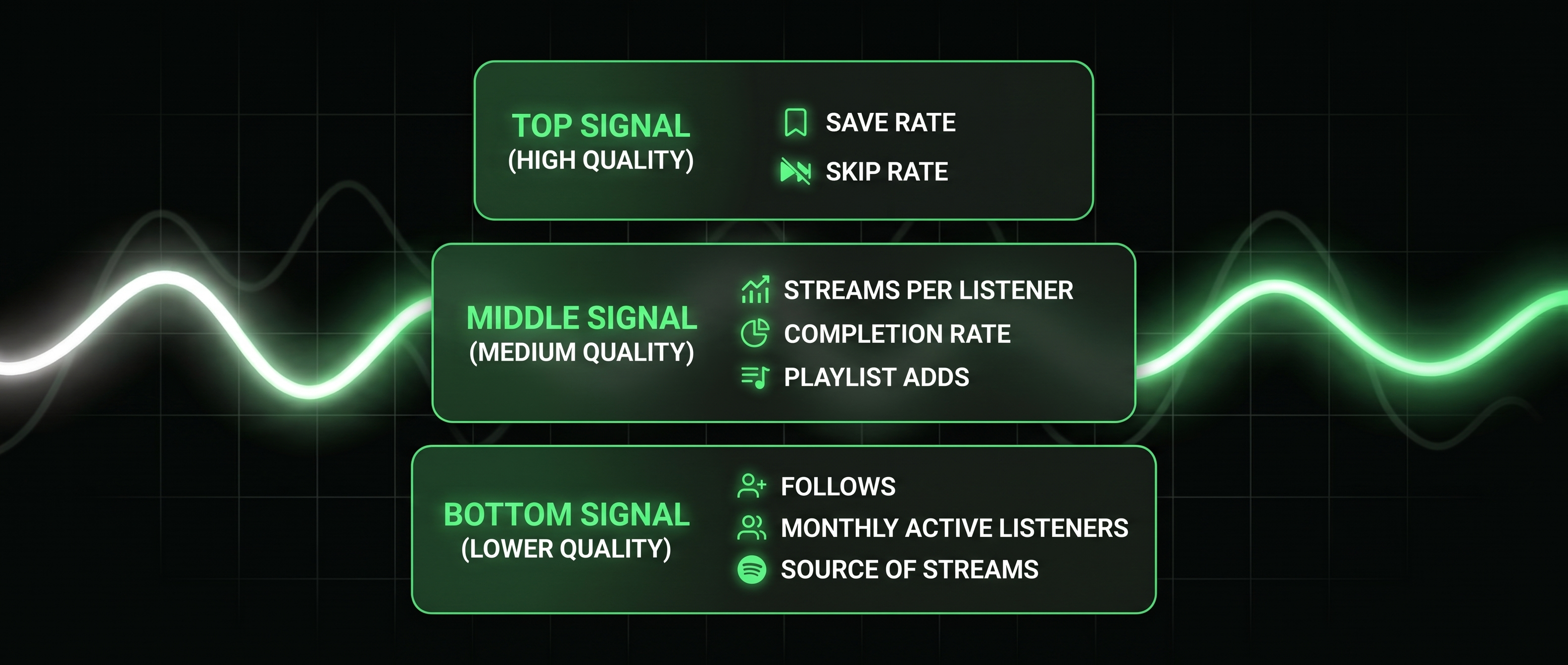
The following signals appear consistently in both the Reddit case study data and Spotify’s own metric surfacing. None are confirmed as direct algorithmic inputs, but they are what Spotify surfaces alongside engagement data and what the community data highlights.
| Signal | Why it matters |
|---|---|
| Streams per listener | Indicates repeat interest, not curiosity that fades after a single play |
| Save rate | Indicates intent to return; the strongest positive quality signal in the recommendation system |
| Skip rate | High skip rates in the first 30 seconds actively suppress algorithmic distribution |
| Completion rate | Percentage of listeners who finish the track; a strong positive signal for continued recommendations |
| Playlist adds | Indicates personal relevance for the listener |
| Follows | Indicates artist level interest |
| Monthly active listeners | Indicates an intentional, current audience |
| Source of streams | Shows whether growth comes from active, programmed, or passive listening |
| Audience coherence | Helps the recommendation system build a clear genre and taste context |
The Reddit track had 3.6 song streams per listener and 3.8 artist streams per listener at the point of Discover Weekly placement. That repeat listening rate is more significant than the 15,141 total stream count.
Third-party campaign data from Chartlex, based on 2,400+ campaigns, suggests tracks with a save rate above 20% and skip rate below 25% in the first two weeks of release are 4x more likely to trigger Discover Weekly placement than tracks with average engagement metrics. These are observed correlations from an independent dataset, not confirmed Spotify thresholds. They are consistent with what Music Tomorrow’s algorithmic research found: what matters is not scale but signal coherence.
How Meta Ads Can Help or Hurt
Most Meta ad campaigns for music are measured against ad platform metrics: cost per link click, CPM, click-through rate. As covered in Soundlink’s attribution guide, none of those figures indicate whether a listener actually streamed the track, saved it, or followed the artist. That gap is where Discover Weekly strategy either works or fails.
Meta ads can help if they drive real listeners who repeat the track, save it, and behave like the artist’s core audience. Meta ads can produce the wrong outcome if they drive low intent traffic that inflates stream count without raising streams per listener or other engagement metrics.
Meta ads build recommendation potential when they drive listeners who:
- Complete the track and return to it multiple times
- Save the track or add it to personal playlists
- Follow the artist on Spotify
- Listen to adjacent catalog
- Match the genre and taste profile consistent with the artist’s core audience
Meta ads underperform or damage signal quality when they drive:
- High CTR, low intent traffic that bounces at the smart link
- Cheap streams from markets that do not match the artist’s core audience profile
- Fragmented listener taste profiles that give the recommendation system conflicting signals
- Listeners who play a track once and do not return, raising stream count without raising streams per listener
Skip rate is the clearest indicator of traffic quality from ad campaigns. A listener delivered by a Meta ad who skips the track before 30 seconds is not a neutral data point. Spotify logs that skip as a negative signal. A campaign that drives high CTR but high skip rates is actively damaging the recommendation potential of the track. High skip rate suppresses saves. Fewer saves reduce Radio and Discover Weekly eligibility. The damage compounds.
This is the core tension in Discover Weekly strategy. A Meta campaign optimized purely for low CPL can produce the wrong kind of listener signal. Volume at low cost looks efficient by ad platform metrics while weakening the Spotify side data the recommendation system needs.
The question operators should be asking is not “how many listeners did this campaign generate?” It is “are those listeners completing the track, saving it, and coming back?”
A Practical Campaign Framework
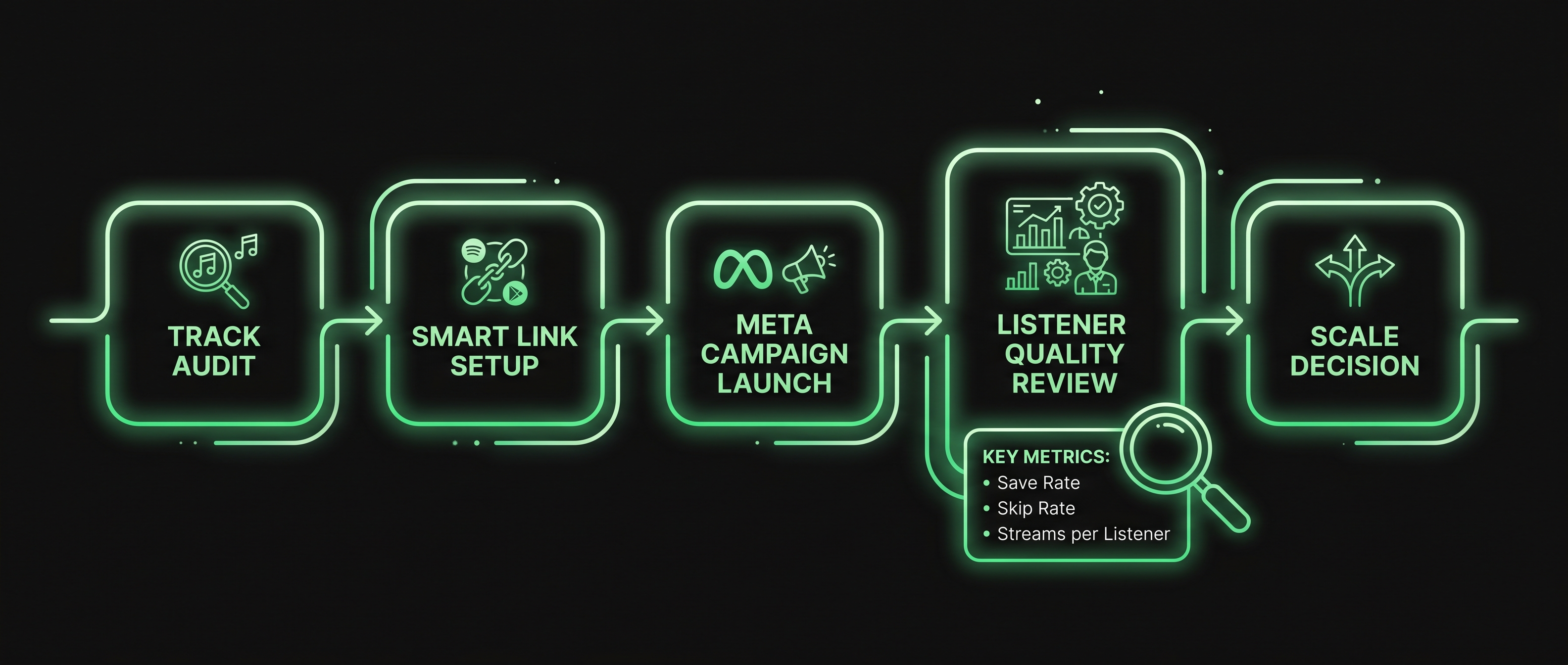
Based on the Reddit case study data, Spotify’s official statements, and Music Tomorrow’s research, the following framework is defensible for marketers running Meta campaigns with Spotify outcomes in mind.
- Audit repeat listening before scaling. If streams per listener is low in organic listening data, paid campaigns are unlikely to correct that. Start with a track that already shows listener retention.
- Run Meta ads to a clean, attributable Spotify path. Attribution at the ad set level matters. Knowing which listener segments came from which targeting is the foundation for quality-based optimization.
- Optimize against listener quality metrics. CPL is a useful headline metric. Cost per save and cost per follower are more predictive of whether a campaign is generating algorithmically useful listeners.
- Track streams per listener, save rate, and playlist adds over the campaign period. A campaign raising streams per listener and save rate week over week is building recommendation potential. A campaign raising total streams with a rising skip rate is not.
- Monitor source of stream movement in Spotify for Artists. An increase in programmed streams, Radio, and Autoplay during or after a paid campaign indicates the recommendation system is beginning to test the track.
- Scale spend only after the audience shows repeat behavior. Increasing budget before that pattern is established produces volume at the wrong signal quality.
Most artists running this strategy see the first meaningful Discover Weekly activity 3 to 4 weeks after a campaign begins building clean engagement signals. Spotify tests tracks first in Radio and Daily Mix. If listeners in those test placements save and repeat the track, Spotify expands it to Discover Weekly. That test period is where save rate and skip rate data are most consequential.
How Soundlink Measures Listener Quality at the Campaign Level
Most Meta campaigns for music are evaluated against ad platform metrics: cost per link click, CPM, click-through rate. None of those indicate whether a listener streamed the track, saved it, or followed the artist.
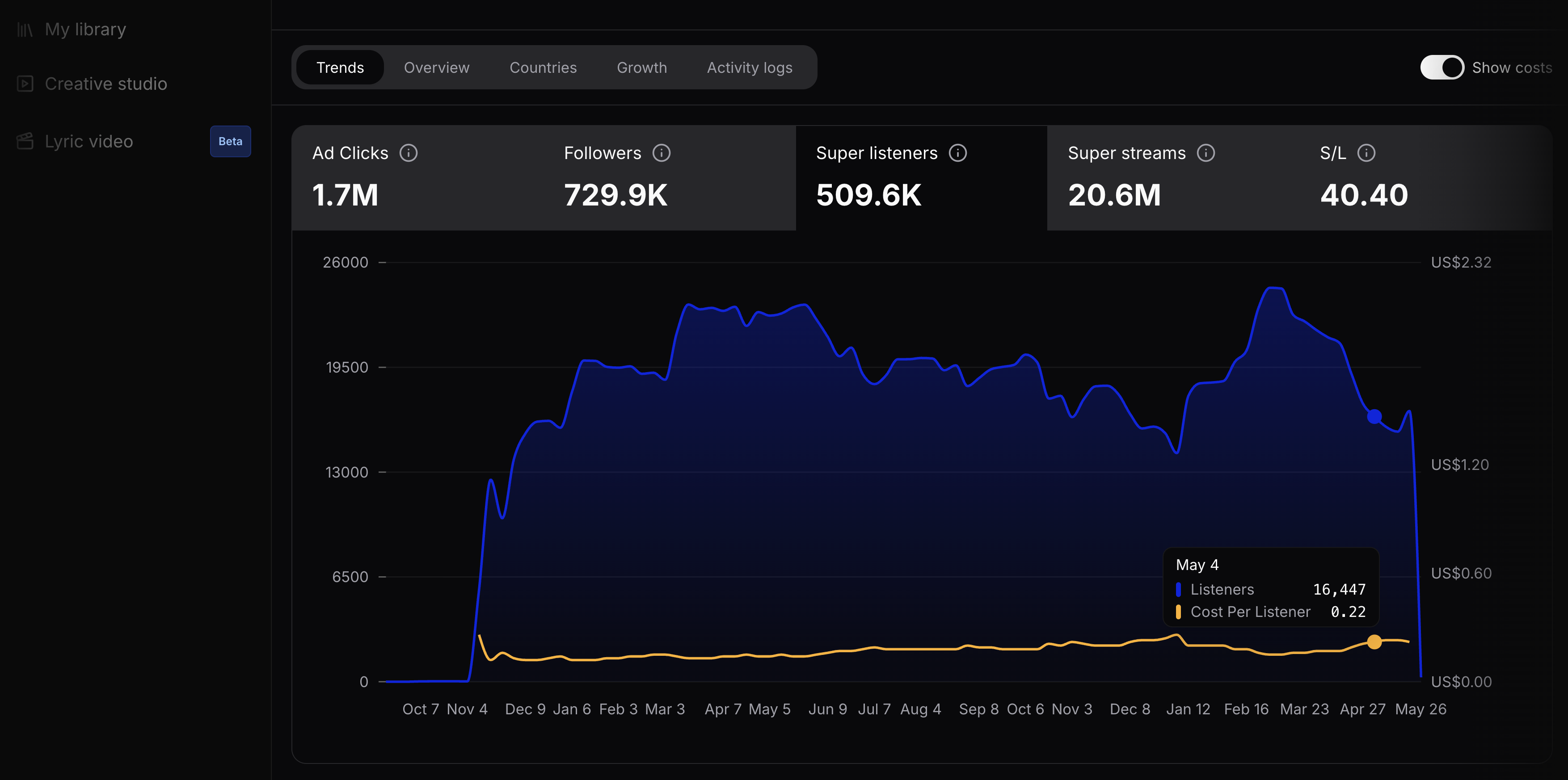
Soundlink’s paid campaigns report Spotify side outcomes alongside ad spend, using Spotify side measurement that goes beyond landing page proxies. The metrics visible in the platform include cost per listener, cost per follower, and cost per save, calculated at the campaign and ad set level.
That changes the optimization target for teams running Discover Weekly oriented campaigns. A campaign reporting only ad platform metrics cannot show whether it is generating the kind of listener behavior that builds algorithmic potential. A campaign reporting attributed saves, follows, and repeat streams alongside spend can.
The strongest signal from the Reddit case study was not total streams. It was the repeat listening rate: 3.6 streams per listener. Soundlink’s paid campaigns give operators the measurement layer needed to see whether a Meta campaign is producing that quality of listener or producing clicks.
Soundlink’s paid campaigns are separate from Spotify’s own Discovery Mode, which operates inside Spotify’s recommendation system. Both affect algorithmic reach through different mechanisms and require the same underlying listener quality to sustain results.
Frequently Asked Questions
Is there a Spotify Discover Weekly popularity score threshold?
There is no confirmed threshold. Artist reported data suggests many tracks receive Discover Weekly placement around a popularity score of 25 to 35, but Spotify does not publish a trigger point. Popularity score is an outcome of recent listening behavior, not a confirmed input to the recommendation system.
What is a good streams per listener ratio on Spotify?
There is no single benchmark, but a streams per listener ratio above 2.5 generally indicates meaningful repeat listening. The Reddit case study track had a ratio of 3.6 at the point of Discover Weekly placement. A ratio below 1.5 on a recently released track typically indicates listeners are not returning, which limits the quality of data available to the recommendation system.
What save rate do I need to get on Discover Weekly?
Spotify does not publish a required save rate. Third-party campaign data from Chartlex suggests tracks with a save rate above 20% from cold listeners are substantially more likely to receive Discover Weekly placement than tracks with single-digit save rates. A save rate above 5% is a baseline indicator of meaningful listener intent. These are observed correlations, not confirmed Spotify thresholds.
What skip rate hurts my chances of getting on Discover Weekly?
Skip rates above 30% in the first 30 seconds are associated with reduced algorithmic distribution across Radio and Discover Weekly. Spotify logs early skips as negative signals. A campaign driving high CTR but high skip rates is actively weakening the recommendation potential of the track, because high skip rate suppresses save activity, and saves are the primary quality indicator for the recommendation system.
How long does it take to get on Spotify Discover Weekly?
Most artists see the first meaningful Discover Weekly activity 3 to 4 weeks after a campaign begins building clean engagement signals. Spotify typically tests tracks in Radio and Daily Mix first. If listeners in those placements save and repeat the track, Spotify expands distribution to Discover Weekly. Tracks that spike in streams but show low save rates and high skip rates often fail to advance past the Radio test phase.
Does running Meta ads help get a song on Discover Weekly?
Meta ads can help if they drive real listeners who repeat the track, save it, and match the artist’s core audience profile. Meta ads can produce the wrong outcome if they drive low intent traffic that inflates stream count without raising save rate or reducing skip rate. The ad platform metric that predicts Discover Weekly potential is not CPL. It is cost per save and cost per follower.
How does Spotify calculate popularity score?
Spotify defines track popularity as a value from 0 to 100, calculated algorithmically and based primarily on total plays and how recent those plays are. The value can lag a few days behind actual listening activity and is not updated in real time.
What is the difference between monthly listeners and monthly active listeners on Spotify?
Monthly listeners counts all unique listeners in a rolling 28 day window. Monthly active listeners is a narrower subset that excludes low engagement or passive listeners. The gap between the two is a rough indicator of how intentional the listening is.
How do I measure whether a Meta ad campaign is building Spotify algorithmic potential?
Track Spotify for Artists source of stream data alongside streams per listener, save rate, skip rate, and follows during and after the campaign period. A campaign that drives rising streams per listener and save behavior while keeping skip rate low is more likely producing usable recommendation signals than one that increases total stream count alone. Soundlink’s paid campaigns report these Spotify side metrics directly against ad spend at the ad set level.
Is Discover Weekly the only algorithmic surface worth targeting?
No. Spotify lists Discover Weekly, Radio and Autoplay, Mixes, Release Radar, and personalized editorial playlists as part of the same personalized recommendation ecosystem. Spotify states that 33% of new artist discoveries happen through these surfaces. Discover Weekly is one surface in a wider algorithmic layer. The same listener behavior that creates conditions for Discover Weekly placement also builds potential across Radio, Autoplay, and Mixes.