
You run a Meta campaign for a new release. Listener volume increases. Spotify Radio starts contributing streams. Then Discover Weekly appears in Spotify for Artists.
At that point, many artists ask the same question:
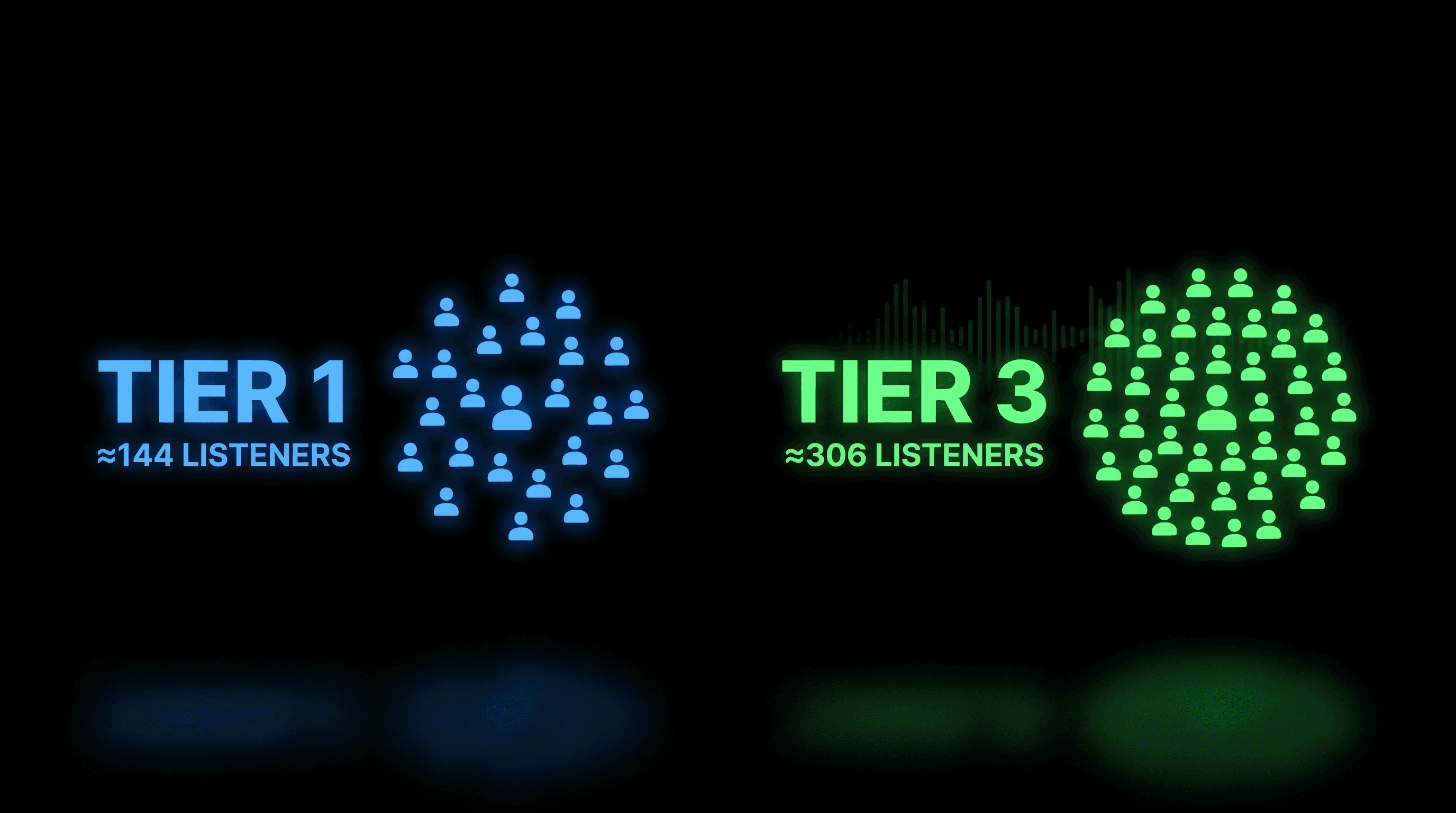
Should I turn off the ads now that Spotify is recommending the track?
Usually, no.
Getting picked up by an algorithmic playlist means Spotify has started distributing the track through one of its programmed recommendation surfaces. It does not mean the release has become self-sustaining, and Spotify does not publish any threshold at which external promotion is no longer necessary.
Artists are already discussing this exact situation in music marketing communities, including cases where a track has triggered Discover Weekly and Radio while the artist is still spending daily on Meta ads. One recent Reddit discussion centered on whether the correct move was to stop, reduce, or continue paid promotion after algorithmic pickup.
The better question is:
What happens to listener acquisition, active listening, and programmed streams when paid spend is reduced?
That is what should determine the next step.
What Programmed Listening Actually Means
Spotify for Artists separates listening into active and programmed sources.
According to Spotify’s source-of-streams documentation, Discover Weekly, Radio, Autoplay, Release Radar, Daily Mix, daylist, AI DJ, and several other recommendation surfaces fall under programmed listening.
| Stream type | What it means | Examples |
|---|---|---|
| Active | The listener intentionally chooses your music |
Artist profile, release page, saved library, own playlists, queue |
| Programmed | Spotify or another listener selects the music for them |
Discover Weekly, Radio, Autoplay, Release Radar, Daily Mix |
This distinction matters.
A programmed stream and a listener returning to your track from their own library are both streams, but they represent different levels of intent.
Spotify also separates an artist’s audience into groups including:
| Audience segment | What it means |
|---|---|
| Monthly active listeners | Listeners who intentionally streamed the artist during the previous 28 days |
| Previously active listeners | Listeners who were previously active but have not intentionally streamed in the current 28-day period |
| Programmed listeners | Listeners who only heard the artist through programmed sources |
Spotify’s own audience segmentation data shows why this distinction matters.
Monthly active listeners make up roughly 33% of the average artist’s total audience but account for around 60% of streams.
Spotify also states that listeners who actively stream an artist play that artist’s music around four times more over the following six months, on average.
For music marketers, that makes active audience growth more useful than looking at total monthly listeners alone.
Algorithmic Pickup Is Not a Stop Signal
A common release campaign looks like this:
- Release the track.
- Start Meta ads.
- Acquire listeners.
- Generate saves, follows, and repeat listening.
- Spotify Radio starts contributing traffic.
- Algorithmic playlists start contributing traffic.
- Stop the ads.
Step seven is where the logic becomes weak.
Spotify does not publish a specific:
- stream threshold
- popularity score
- save rate
- listener count
- advertising threshold
that guarantees continued algorithmic distribution.
A track can enter an algorithmic playlist and still receive a relatively small number of programmed streams.
It can also receive algorithmic traffic for a period and then lose it.
Spotify’s recommendation systems continue responding to listener behavior, personalization, and other factors over time.
Algorithmic pickup should therefore be treated as another distribution source entering the campaign mix.
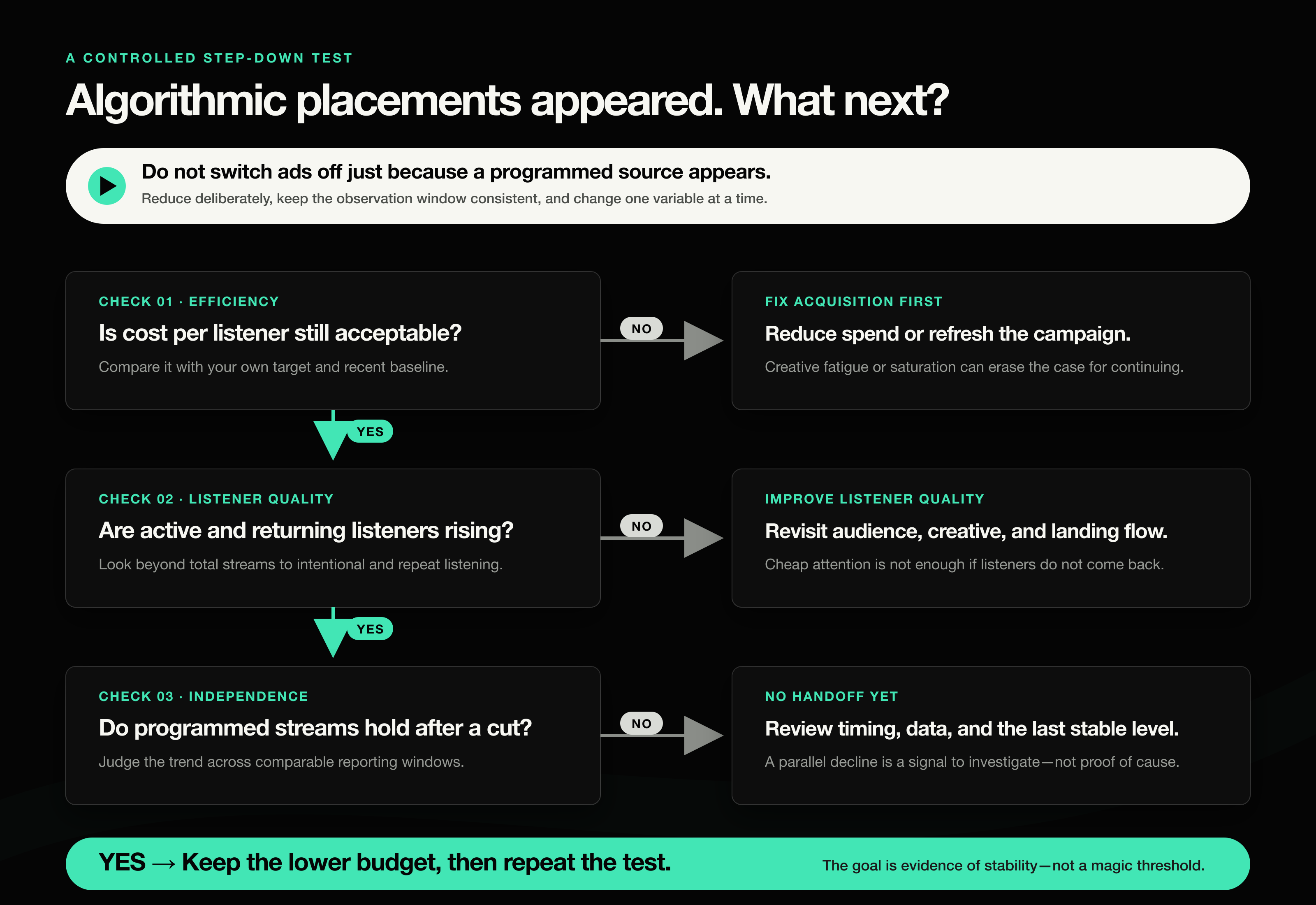
The next step is to test how much of the release’s performance can hold without the same level of paid acquisition.
The Paid-to-Programmed Handoff
A useful campaign framework is to monitor the point where Spotify’s programmed distribution becomes large and stable enough that external acquisition can be reduced.
Consider this example.
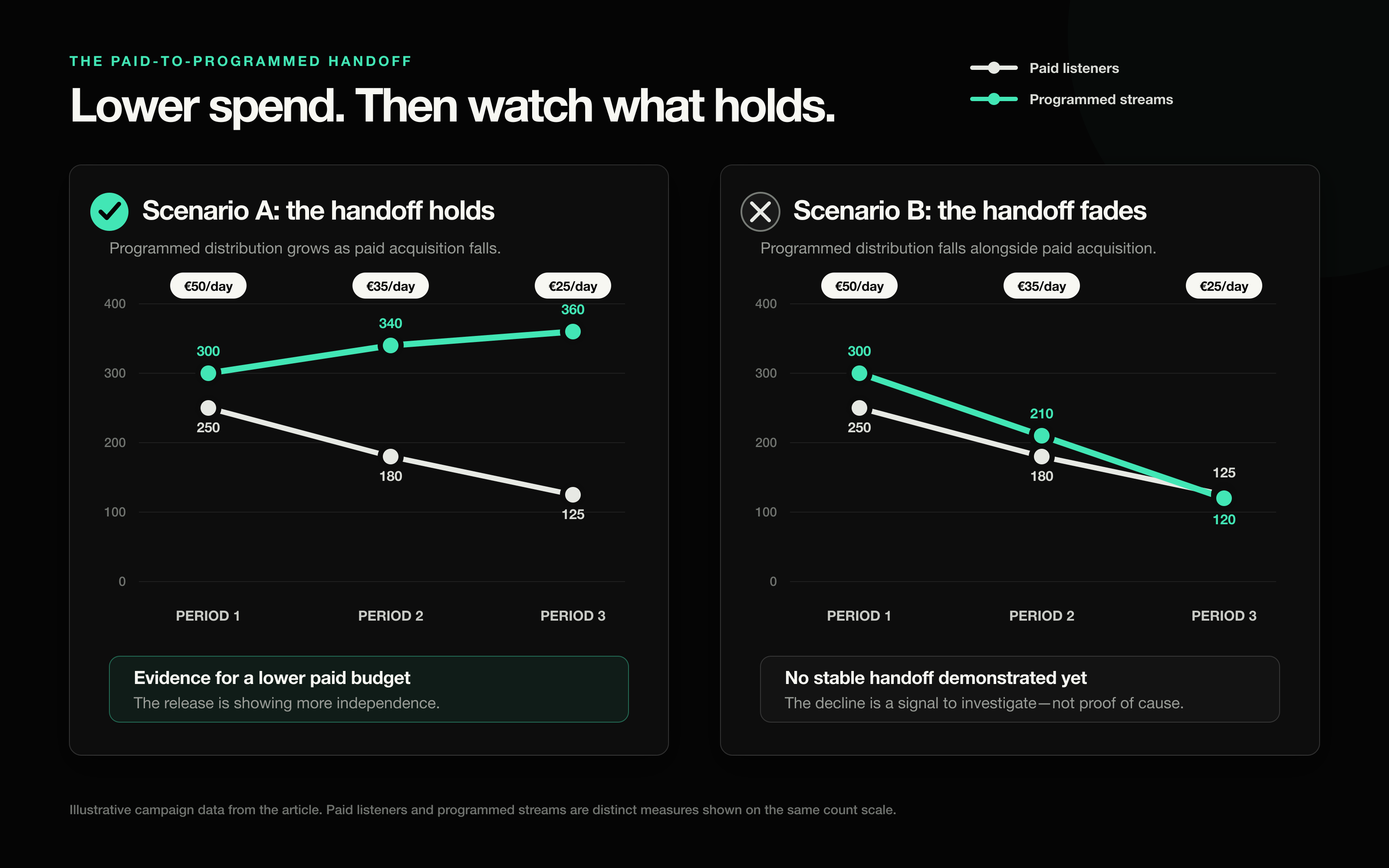
Scenario A: Programmed traffic holds while spend falls
| Period | Meta spend | Paid listeners | Programmed streams |
|---|---|---|---|
| Period 1 | €50/day | 250/day | 300/day |
| Period 2 | €35/day | 180/day | 340/day |
| Period 3 | €25/day | 125/day | 360/day |
Paid acquisition is falling, but Spotify’s programmed distribution continues increasing.
That suggests the release may be able to operate with a lower paid budget.
Now compare it with this.
Scenario B: Programmed traffic falls alongside spend
| Period | Meta spend | Paid listeners | Programmed streams |
|---|---|---|---|
| Period 1 | €50/day | 250/day | 300/day |
| Period 2 | €35/day | 180/day | 210/day |
| Period 3 | €25/day | 125/day | 120/day |
Here, programmed traffic declines as external acquisition declines.
That does not prove that the budget cut directly caused the algorithmic drop. Spotify does not expose enough information to establish that causality from a single campaign.
It does tell you that the release has not demonstrated the same ability to maintain programmed volume at the lower acquisition level.
That is useful information.
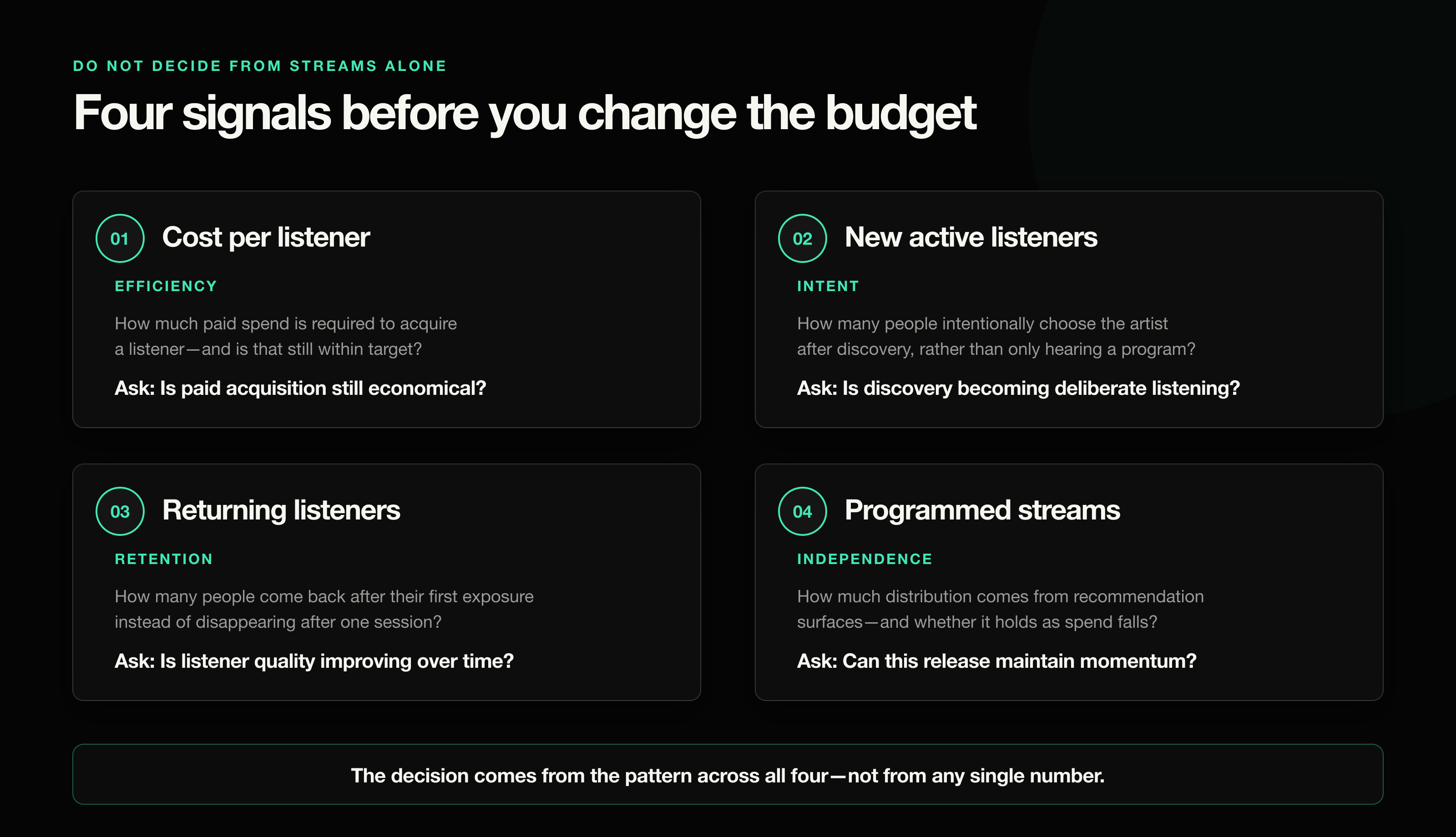
Do Not Make the Decision Based on Streams Alone
Total streams tell you how much listening happened.
They do not tell you:
- where the listener came from
- what the listener cost to acquire
- whether they saved the track
- whether they followed the artist
- whether they came back
- whether they explored the catalog
- whether Spotify started distributing the track independently
A better campaign view combines acquisition efficiency with listener quality.
| Metric | What it tells you | Why it matters |
|---|---|---|
| Cost per listener | Cost of acquiring a Spotify listener |
Paid acquisition efficiency |
| Cost per follower | Cost of acquiring a Spotify follower |
Artist-level conversion |
| Streams per listener | Average listening depth | Repeat consumption |
| New active listeners | Listeners moving into intentional listening |
Quality of discovery |
| Returning listeners | People coming back after first exposure |
Retention |
| Saves | Listeners keeping the track | Track-level engagement |
| Programmed streams | Spotify-driven distribution | Algorithmic contribution |
| Catalog streams | Listening beyond the promoted track |
Artist-level engagement |
No single metric should determine whether a campaign stays on.
The useful information comes from how these metrics develop together.
Cost Per Listener
Cost per listener, a conversion metric exclusive to Soundlink, tells you whether Meta is still acquiring Spotify listeners efficiently.
If CPL remains within your target range, there may be no reason to stop an efficient acquisition channel just because programmed traffic has appeared.
If CPL begins increasing materially, possible causes include:
- creative fatigue
- audience saturation
- higher auction costs
- weaker audience expansion
- declining creative performance
At that point, reducing spend or moving budget to stronger creatives, territories, or releases may make sense.
New Active Listeners
New active listeners are particularly useful because they help distinguish exposure from intentional engagement.
A programmed listener may hear your song because Spotify placed it in front of them.
An active listener deliberately chooses to listen.
Spotify’s audience model is specifically designed to show this difference.
If a release continues adding new active listeners while a paid campaign is running, the campaign may be contributing more than temporary stream volume.
It is helping build an audience that intentionally engages with the artist.
Returning Listeners
First-time listening tells you whether somebody was successfully acquired.
Returning listening tells you whether they came back.
This distinction becomes important when comparing campaigns.
Consider two tracks:
| Track | New listeners | Returning listeners |
|---|---|---|
| Track A | 10,000 | 500 |
| Track B | 7,000 | 1,800 |
Track A acquired more people.
Track B may have created a more valuable audience.
For artist development, retention should be evaluated alongside acquisition volume.
Streams Per Listener
Streams per listener provides another view of listening depth.
| Release | Streams | Listeners | Streams per listener |
|---|---|---|---|
| Track A | 10,000 | 9,000 | 1.11 |
| Track B | 10,000 | 5,000 | 2.00 |
Both tracks generated 10,000 streams.
The behavior behind those streams is very different.
Streams per listener should not be treated as a fixed quality score. Genre, release age, playlist exposure, and listener context can all affect it.
It is more useful when comparing:
- periods
- campaigns
- territories
- releases
- audience cohorts
Saves
Saves can help indicate whether a listener wants to retain the track for future listening.
Spotify has also used saves as one of several positive signals when evaluating recommendation quality in its own research.
In Spotify Research’s work on music discovery, actions such as saving a track, visiting an artist or album page, and continuing to listen after discovery were treated as useful indicators of a successful recommendation experience.
That does not mean there is a published save-rate threshold that triggers programmed distribution.
Spotify does not provide one.
Save rate is better used comparatively.
Compare it across:
- releases
- periods
- audiences
- territories
- traffic sources
Avoid treating an arbitrary percentage as an algorithmic trigger.
Followers
Followers establish an ongoing relationship between the artist and listener inside Spotify.
They can also affect future release distribution.
Spotify confirms that followers can receive new music through Release Radar.
For campaigns focused on long-term artist development, cost per follower can therefore provide more strategic value than cost per stream.
A campaign that generates fewer streams but materially more followers may be the better campaign.
Programmed Streams
Programmed streams tell you how much distribution Spotify and other programmed surfaces are contributing.
Track the direction, not just the number.
| Trend | What it may indicate |
|---|---|
| Increasing | Spotify is expanding distribution |
| Stable | Programmed support is holding |
| Declining | Algorithmic distribution is weakening |
| Increasing while paid spend falls |
The release may require less external support |
| Falling while paid spend falls |
External acquisition may still be contributing to momentum |
Absolute volume still matters.
A 50% increase from 20 to 30 programmed streams is very different from an increase from 5,000 to 7,500.
Reduce Budget in Stages
If a track has started receiving meaningful algorithmic traffic, cutting the Meta budget from 100% to zero immediately gives you limited information.
A staged reduction provides a better test.
Example
| Week | Daily budget | Goal |
|---|---|---|
| Week 1 | €50 | Establish baseline |
| Week 2 | €40 | Test first reduction |
| Week 3 | €30 | Check whether programmed volume holds |
| Week 4 | €20 | Continue testing if performance remains stable |
During each period, monitor:
- CPL
- CPF
- attributed streams
- new listeners
- returning listeners
- total Spotify streams
- active streams
- programmed streams broken out by source
- saves
- follower growth
Try to keep the rest of the campaign reasonably stable.
If you lower the budget, replace every creative, change countries, and restructure the campaign at the same time, it becomes difficult to determine what caused the performance change.
Use rolling periods rather than reacting to one day of Spotify data.
Seven-day comparisons are often more useful because recommendation surfaces can fluctuate significantly from day to day.
Watch Programmed Share of Streams
Another useful metric is:
Programmed share = programmed streams / total streams
Example:
| Period | Total streams | Programmed streams | Programmed share |
|---|---|---|---|
| Week 1 | 10,000 | 1,000 | 10% |
| Week 4 | 18,000 | 7,200 | 40% |
Spotify is now contributing a much larger share of the track’s overall distribution.
If Meta spend also decreased during that period, the case for reducing paid support becomes stronger.
However, programmed share can be misleading when viewed alone.
| Period | Total streams | Programmed streams | Programmed share |
|---|---|---|---|
| Week 1 | 18,000 | 7,200 | 40% |
| Week 2 | 8,000 | 4,000 | 50% |
Programmed share increased from 40% to 50%.
Programmed volume actually fell.
Total streams also fell by more than half.
Always look at both programmed share and absolute programmed volume.
Separate Discovery From Fan Development
Programmed sources are discovery surfaces.
A listener hearing a track there does not automatically become an active fan.
This is one reason monthly listeners can grow faster than:
- followers
- saves
- returning listeners
- catalog streams
- active audience
It helps to separate release performance into two groups.
Discovery
| Metric | What it measures |
|---|---|
| New listeners | Audience reach |
| Programmed listeners | Recommendation exposure |
| Algorithmic playlist streams | Personalized discovery |
| Radio streams | Algorithmic adjacency |
| Autoplay streams | Passive discovery |
Fan development
| Metric | What it measures |
|---|---|
| New active listeners | Intentional listening |
| Followers | Artist-level conversion |
| Saves | Track retention |
| Returning listeners | Repeat engagement |
| Catalog streams | Cross-release engagement |
| Streams per listener | Listening depth |
A campaign should not be judged only on how much discovery it creates.
The important question is how much of that discovery converts into an active audience.
When Should You Keep the Ads Running?
Keep paid promotion running when the campaign is still acquiring valuable listeners efficiently.
| Signal | What it suggests |
|---|---|
| CPL remains within target | Acquisition remains efficient |
| CPF remains within target | Followers are being acquired efficiently |
| New active listeners continue growing |
Discovery is converting into intentional listening |
| Returning listener volume grows |
Retention is improving |
| Saves remain healthy | Track-level engagement remains strong |
| Programmed streams are increasing |
Spotify is adding distribution |
| Catalog activity increases | Listeners are exploring beyond one release |
In this situation, programmed distribution is additive.
Spotify is contributing another acquisition source while Meta continues to bring new listeners into the system.
Stopping an efficient campaign solely because programmed traffic appeared can remove a useful source of growth.
When Should You Reduce Spend?
Reducing spend makes sense when Spotify’s own distribution is becoming a larger and more stable component of the release.
| Signal | Possible action |
|---|---|
| Programmed streams remain stable after budget reduction |
Test another reduction |
| Programmed streams grow while paid acquisition declines |
Stronger case for lower paid support |
| Active listener growth holds | External acquisition may be less necessary |
| Returning listeners continue increasing |
Retention is supporting the release |
| CPL begins increasing | Consider reducing or reallocating budget |
| CPF deteriorates | Artist-level acquisition is becoming less efficient |
| Frequency rises significantly | Audience saturation may be developing |
| Creative performance declines | Refresh creatives or reduce spend |
At that point, the next euro may produce a better return elsewhere.
That could include:
- another release
- another territory
- new creative
- another audience
- retargeting
- catalog promotion
- an upcoming release campaign
The objective is efficient budget allocation across the artist’s catalog.
When Should You Stop the Campaign?
A campaign should usually stop because its marginal performance no longer justifies the spend.
Not because an algorithmic playlist appeared.
| Condition | Why it matters |
|---|---|
| CPL exceeds your acceptable range |
Listener acquisition is no longer efficient |
| CPF deteriorates substantially | Artist-level conversion is weakening |
| Returning listener growth is weak |
Acquisition is not producing retention |
| Creative fatigue persists | Additional spend is unlikely to restore efficiency |
| Audience saturation is high | Incremental listeners become more expensive |
| Active-listener conversion is weak |
Paid traffic is not developing into deeper engagement |
| Programmed distribution remains negligible |
Spotify is contributing little incremental reach |
| Another release performs materially better |
Budget has a higher-value use elsewhere |
Opportunity cost matters.
If another track can acquire better listeners at a lower cost, continuing to fund the weaker release may not make sense.
What If Programmed Traffic Drops After You Reduce Spend?
Do not immediately assume the budget reduction caused it.
Spotify does not provide enough recommendation-system data to establish causality from a single campaign change.
Programmed distribution can change because of:
- listener response
- personalization
- release age
- playlist refreshes
- audience fit
- listener behavior
- changes to Spotify’s recommendation products
- other variables Spotify does not expose
Spotify’s discovery products are also continuing to change.
In July 2026, Spotify announced further changes to discovery-driven playlists and Release Radar personalization.
Artists have also reported changes in the amount of traffic they receive from Radio, Discover Weekly, and other programmed sources during 2026.
Those reports are useful observations.
They are not evidence of a specific ranking-factor change unless Spotify confirms one.
This is why fixed rules such as:
“Reach popularity score 30 and Spotify will push the track”
should be treated carefully.
Spotify does not publish a guaranteed popularity-score threshold for any programmed source.
The Attribution Problem
This entire decision becomes harder because Meta and Spotify do not provide native end-to-end attribution.
Meta can measure:
- impressions
- clicks
- landing-page events
- configured conversion events
Spotify for Artists can measure:
- streams
- listeners
- saves
- followers
- sources of streams
- audience segments
But the platforms do not natively answer questions such as:
| Question | Native cross- platform answer? |
|---|---|
| Which Meta ad produced this Spotify listener? |
No |
| Which creative produced the strongest listeners? |
No |
| Which ad set produced the most Spotify followers? |
No |
| Which campaign generated the highest repeat listening? |
No |
| How much of Spotify growth came from paid acquisition? |
Not directly |
This becomes particularly important once Spotify starts contributing programmed traffic.
Imagine streams increase from 1,000 to 3,000 per day while a Meta campaign is running.
The additional 2,000 streams could include:
- listeners acquired through Meta
- repeat streams from previous campaign listeners
- algorithmic playlists such as Discover Weekly
- Spotify Radio
- Autoplay
- user playlists
- organic activity unrelated to the campaign
You cannot attribute all incremental Spotify growth to Meta simply because the campaign was active at the same time.
This is why Spotify attribution for Meta campaigns needs to be evaluated separately from aggregate Spotify for Artists growth.
How Soundlink Fits Into the Decision
Soundlink connects Meta campaign activity with downstream Spotify performance so artists, labels, and music marketers can evaluate campaigns beyond clicks and landing-page conversions.
That gives you a paid acquisition layer alongside the wider Spotify for Artists data.
Paid campaign performance
Depending on the campaign and available Spotify data, key metrics can include:
- cost per listener
- cost per follower
- cost per stream
- attributed Spotify streams
- streams per listener
- returning listener behaviour
Spotify ecosystem performance
Spotify for Artists can then be used to monitor:
- total listeners
- monthly active listeners
- programmed listeners
- active streams
- programmed streams by source
- saves
- audience growth
- catalog behaviour
These are two different questions.
Paid acquisition performance:
What did the campaign acquire, and at what cost?
Spotify ecosystem performance:
What happened to the release once those listeners entered Spotify?
Both matter when deciding whether to continue funding a release.
A Practical Decision Framework
If your track has been picked up by an algorithmic playlist, use the following process.
Step 1: Establish a baseline
Record the current state before changing the campaign.
| Meta / attribution | Spotify for Artists |
|---|---|
| Spend | Total streams |
| CPL | Active streams |
| CPF | Programmed streams |
| Cost per stream | Algorithmic playlist streams |
| Attributed streams | Radio streams |
| Streams per listener | Saves |
| Returning listeners | Monthly active listeners |
Step 2: Measure the trend
Use rolling periods.
Determine whether programmed distribution is:
- growing
- stable
- declining
Do the same for active listeners, returning listeners, CPL, and CPF.
Step 3: Reduce spend incrementally
Lower the budget rather than turning the campaign off immediately.
Keep other major campaign variables as stable as possible.
Step 4: Measure the response
| Question | What it helps test |
|---|---|
| Did programmed streams decline? |
Whether Spotify distribution held at lower spend |
| Did active listening decline? |
Whether intentional audience growth weakened |
| Did returning listeners change? |
Whether retention changed |
| Did follower acquisition change? |
Whether artist-level conversion weakened |
| Did CPL change? | Whether listener acquisition became more or less efficient |
| Did CPF change? | Whether follower acquisition became more or less efficient |
| Did total listener growth hold? |
Whether overall release momentum remained stable |
Step 5: Find the lowest efficient spend level
Continue testing until one of two things happens:
- Further reductions materially weaken acquisition or release performance.
- Paid acquisition is no longer financially or strategically attractive.
That becomes the current support level for the release.
It does not need to remain fixed.
If programmed traffic strengthens later, reduce again.
If an efficient new creative substantially improves acquisition economics, increasing budget may make sense again.
So, Should You Turn Off Meta Ads After Hitting Discover Weekly?
Not automatically.
Discover Weekly confirms that Spotify is recommending the track to some listeners.
It does not confirm that:
- the release is self-sustaining
- external acquisition is no longer valuable
- Spotify will maintain the same distribution level
- the campaign has reached its optimal stopping point
Keep the campaign running while listener acquisition remains efficient and is contributing valuable audience growth.
Reduce spend when programmed distribution, active listening, and retention remain stable with less paid support.
Stop when the marginal value of the next euro is lower than the value you could create elsewhere.
The stopping decision should be based on acquisition efficiency, listener quality, retention, active audience growth, and programmed distribution. Not the appearance of a single Spotify playlist.