


The best countries to target for Spotify promotion are not always the United States, United Kingdom, Canada, and Australia.
Those markets make sense when touring, merchandise, or premium market royalties are the immediate goal. They can be inefficient when the goal is to acquire real listeners, test a release, and build enough quality engagement for Spotify to understand the track.
Tier 2 and Tier 3 markets across Latin America, North Africa, and Southeast Asia can give music marketers access to engaged Spotify audiences at a lower cost. The opportunity is real. The strategy still requires more than a list of cheap countries.
TL;DR
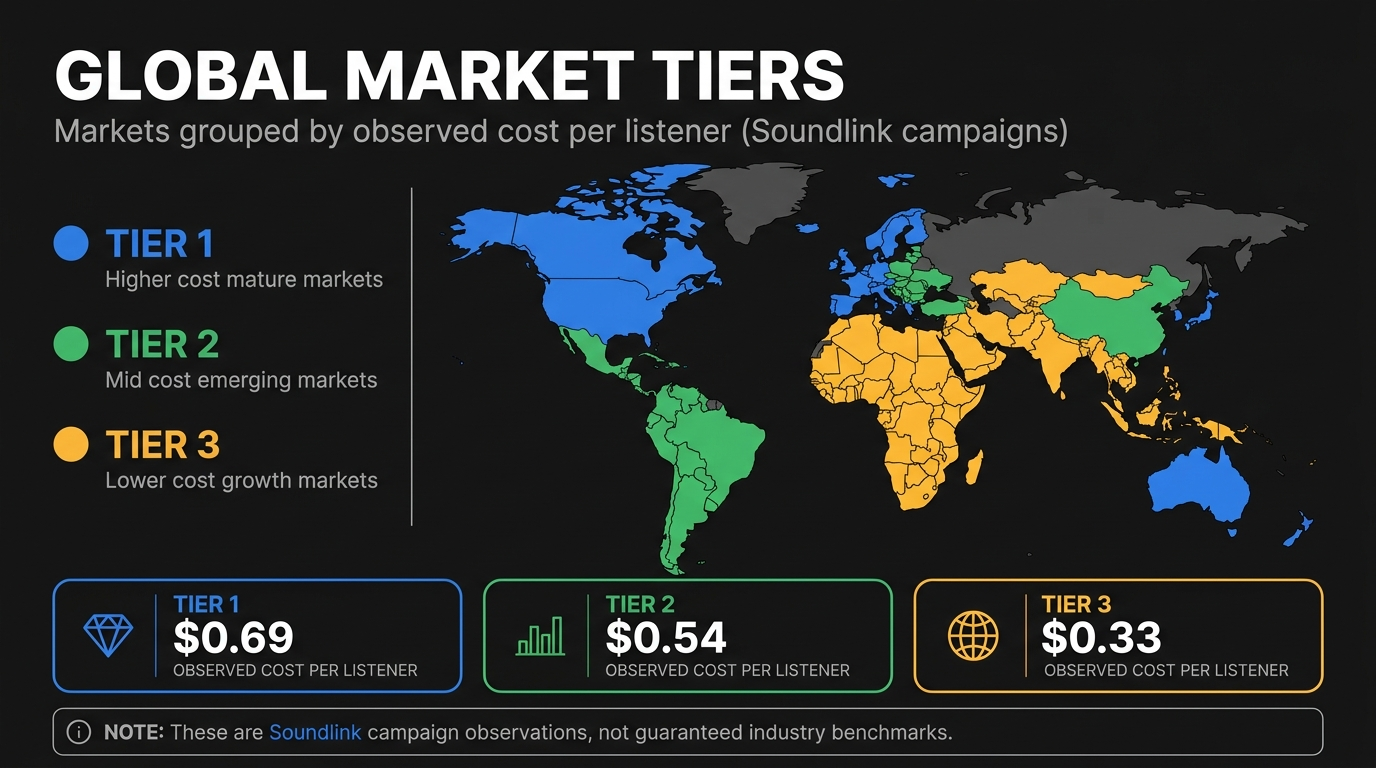
Tier 2 and Tier 3 countries are often better than Tier 1 countries for cost efficient Spotify listener growth through Meta ads. Soundlink campaign data reports an observed an average cost per listener of $0.69 in Tier 1, $0.54 in Tier 2, and $0.33 in Tier 3. That means the same budget can produce a little over twice as many listeners in Tier 3.
The lower cost does not make every listener equally valuable for every goal. Artists should separate market tiers, localize creative, and judge performance by Spotify outcomes such as cost per listener, cost per save, cost per follower, and repeat listening.
Spotify is investing in Latin America, the Middle East and North Africa, and Southeast Asia. That makes these markets strategically important. Spotify has not confirmed that its recommendation systems give streams from those regions extra weight. The defensible advantage comes from lower acquisition costs, growing audiences, and real listener engagement.
The goal is not to buy the cheapest stream. The goal is to acquire the most relevant listener at a sustainable cost.
Why Tier 2 and Tier 3 Spotify promotion costs less
Meta does not set one price for reaching a music listener. Every impression enters an auction.
Meta explains that its ad auction evaluates the objective, budget, audience, duration, and creative. The same music ad can therefore produce very different costs in different countries.
An artist targeting the United States is not competing only with other artists. The campaign enters auctions that also include consumer brands, subscription companies, mobile apps, retailers, and local businesses. Competition from every advertiser category can raise the cost of reaching a qualified listener.
Soundlink’s campaign data shows the result of this broader auction pressure. Premium markets cost more per acquired listener, while many growth markets produce cheaper reach and conversion opportunities even when Spotify engagement is strong.
Soundlink publishes the following observed campaign figures in its music marketing guide:
-
Tier 1, Premium: $0.69 per listener. Example markets include the United States, United Kingdom, Germany, and Australia.
-
Tier 2, Growth: $0.54 per listener. Example markets include Mexico, Argentina, Poland, and Chile.
-
Tier 3, Scale: $0.33 per listener. Example markets include Brazil, India, Indonesia, the Philippines, and Thailand.
These are Soundlink campaign observations. They are not universal benchmarks or guaranteed results. Genre, language, creative, artist recognition, and the conversion path can move the cost in either direction.
The comparison still shows why country selection matters. A campaign that only targets premium markets may pay over twice as much for each listener as a well matched Tier 3 campaign.
Lower cost per result is not the same as lower cost per listener
Music marketers often use CPR to mean cost per result. The problem is that the result may be a landing page view or a button click.
Neither action confirms that the person streamed the track.
A lower cost per result can hide weak Spotify performance. Cheap clicks may fail to open the Spotify app. Listeners may leave before 30 seconds. They may play once and never return.
Country decisions should therefore be based on Spotify side outcomes:
-
Cost per listener: How much spend produced each actual listener.
-
Cost per save: How much spend produced each track save.
-
Cost per follower: How much spend produced each new artist follower.
-
Streams per listener: Whether acquired listeners returned to the track.
-
Catalog activity: Whether listeners explored other songs by the artist.
Soundlink’s Spotify attribution guide explains why Meta click reporting and Spotify for Artists totals do not connect by default.
Spotify says personalized playlists use signals such as listening behavior, playlist additions, and the habits of listeners with similar tastes. A cheap audience that does not engage is not an algorithmic asset.
Why Latin America is a serious Spotify growth market
Latin America combines large Spotify audiences with lower paid social costs than many premium markets.
Spotify reported in 2023 that 21 percent of its global users were in Latin America. It also described the region as having significant room for further growth.
The region is not one audience. Mexico, Brazil, Argentina, Colombia, Chile, and Peru have different languages, genre preferences, media costs, and levels of Spotify penetration.
The strongest starting points depend on the release:
-
Mexico: A useful growth market for Spanish language music and many international pop, rock, electronic, and alternative genres.
-
Argentina and Chile: Lower cost Spanish language markets with established streaming behavior.
-
Brazil: A large scale market that requires Portuguese creative when lyrics or copy carry the campaign.
-
Colombia and Peru: Relevant test markets for Latin genres and for releases already showing organic listener activity in the region.
Spotify continues to build products, editorial programs, and advertising activity around Latin music. In 2025, Spotify reported that Latin music represented 27 percent of global listening on the service.
That does not mean every international artist should target Latin America. It means the region has substantial listening volume, strong platform relevance, and active music discovery.
Why North Africa deserves controlled testing
North Africa is discussed far less often in music advertising guides. It should not be treated as one automatic Tier 3 bundle.
Spotify launched across 13 markets in the Middle East and North Africa with an Arabic service, local playlists, and personalized recommendations. The company has continued to invest in regional editorial teams and artist programs.
In 2025, Spotify described the Middle East and North Africa as the fastest growing recorded music region, citing industry revenue growth of nearly 23 percent during the previous year. Spotify also reported that Arabic was among its fastest growing listening languages and that Egypt showed one of the strongest independent music performances globally.
The opportunity is strongest when the artist has a credible cultural or genre connection. Arabic pop, hip hop, electronic music, Afrobeats, French language music, and instrumental genres may each map to different parts of the region.
Run North African countries as controlled tests. Keep them separate from Latin America and Southeast Asia. Compare actual Spotify outcomes before expanding the budget.
Why Southeast Asia can deliver efficient listener growth
Indonesia, the Philippines, and Thailand appear in Soundlink’s Tier 3 group. These markets combine lower acquisition costs with active music cultures and growing Spotify infrastructure.
Spotify has publicly described Southeast Asia as a region with rapid growth on its free service. It has also invested in local playlists, regional artist programs, and advertising operations.
The Philippines is a clear example of local engagement. Spotify reported in 2024 that its Top 50 in the Philippines was close to 75 percent local music. Global streams of Filipino music had quadrupled over the previous five years.
This evidence does not guarantee that a track from another market will connect. It does show that listeners in the region actively discover, repeat, and export music through Spotify.
Southeast Asia can be especially useful for:
-
Electronic music
-
Pop with a clear visual identity
-
Instrumental music
-
Alternative genres with an existing regional audience
-
Releases already showing listeners in Spotify for Artists from Indonesia, the Philippines, Thailand, Malaysia, or Vietnam
Does Spotify reward growth in emerging markets?
Spotify has a commercial interest in growing Latin America, the Middle East and North Africa, and Southeast Asia. Its local product launches, editorial programs, advertising expansion, and creator initiatives make that clear.
That commercial interest does not prove a geography based algorithm bonus.
Spotify says its personalized recommendations use many signals. These include what a listener plays, when they listen, which tracks they add to playlists, and how people with similar tastes behave. Spotify has not stated that a stream from Brazil, Egypt, or Indonesia receives more recommendation weight because that country is a company growth priority.
Soundlink’s guide to Spotify Discover Weekly and listener quality examines the same distinction. Stream volume can create an opportunity for testing. Engagement quality determines whether the activity is useful.
The more defensible mechanism is simpler.
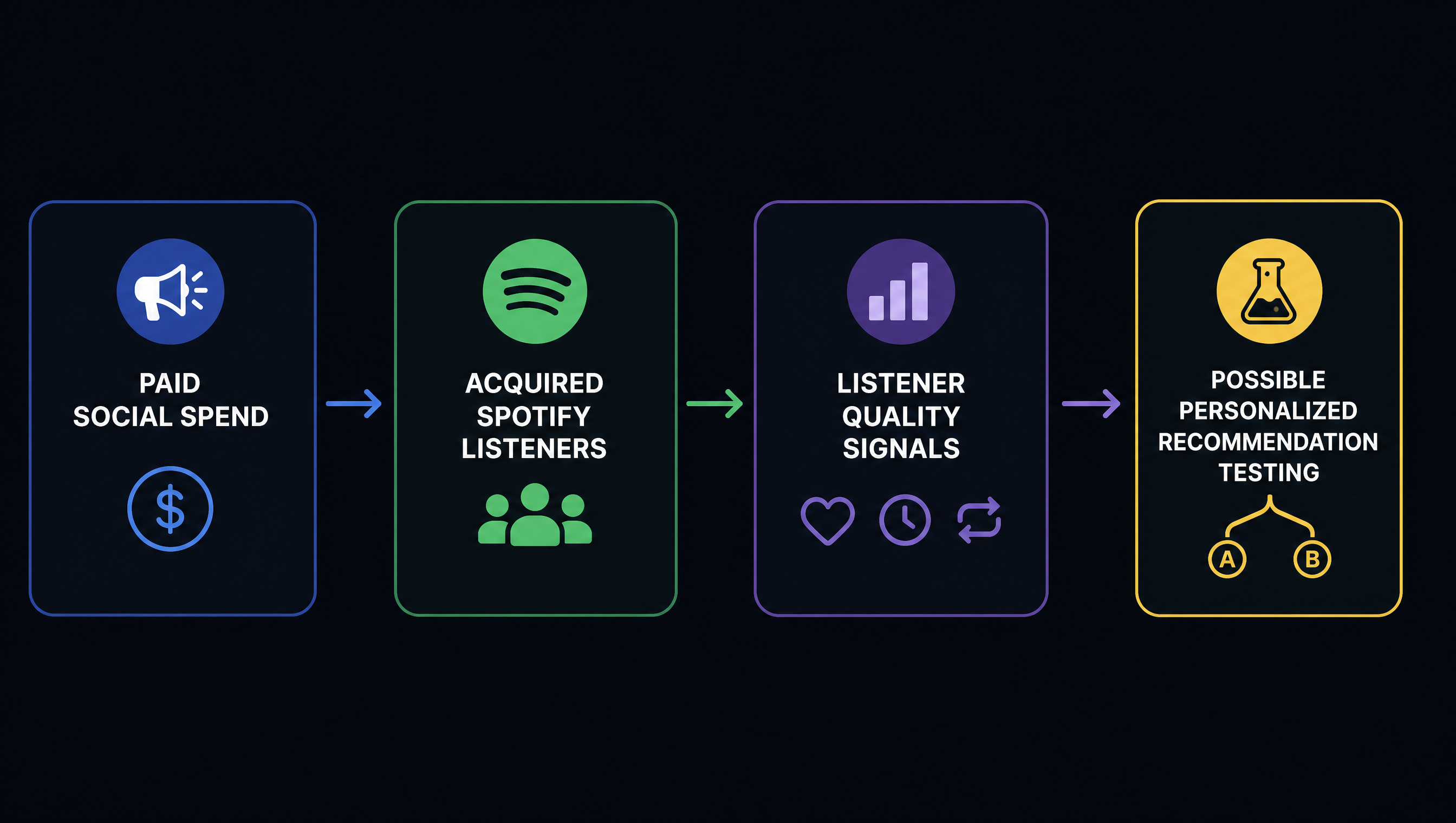
Lower acquisition costs can produce more real listeners from the same budget. More listeners can create more opportunities for saves, follows, repeat plays, and catalog discovery. Those behaviors give Spotify more evidence about which listeners may like the track.
Emerging markets create an efficiency advantage. Listener behavior determines whether that advantage becomes recommendation momentum.
This distinction matters. A campaign should never scale a country only because it generates cheap clicks or streams. It should scale when listeners behave like fans.
When Tier 2 and Tier 3 targeting is the better strategy
Lower cost markets are often the better choice when the primary objective is one of the following:
-
Release testing: Find out whether a track converts before committing a premium market budget.
-
Listener acquisition: Build a larger pool of real listeners at a sustainable cost.
-
Recommendation potential: Generate enough quality behavior for Spotify to understand the audience for the track.
-
Catalog discovery: Acquire listeners who may explore related tracks or artist playlists.
-
Global genre expansion: Reach listeners for electronic, instrumental, dance, ambient, Latin, African, or other genres that travel across borders.
The strategy is weaker when the immediate goal is selling tickets in one city, shipping merchandise to a specific country, building local press proof, or maximizing short term royalty return.
Spotify does not pay a fixed rate for every stream. Its royalty guidance explains that payments depend on streamshare, market revenue, listener plan, and agreements with rightsholders. Premium market listeners may therefore create more direct revenue value even when they cost more to acquire.
The correct country mix follows the commercial goal.
How to structure a multi market Spotify campaign
Putting every country in one ad set gives Meta permission to spend where the selected conversion is cheapest. One or two low cost countries may absorb most of the budget.
That is useful for pure volume. It is weak for learning.
Use separate market groups so each tier produces its own evidence.
1. Separate market tiers
Create distinct ad sets for premium, growth, and scale markets. This prevents the cheapest country from hiding the performance of every other market.
2. Group countries by language and cultural fit
Do not combine Brazil with Spanish speaking Latin America when the creative contains text. Do not treat North Africa as interchangeable with Southeast Asia.
3. Localize the creative
Translate captions, calls to action, and on screen context. Localization matters even when the track itself is instrumental or in English.
4. Optimize for a meaningful conversion
Meta says its delivery system looks for people likely to complete the action connected to the campaign objective. A traffic objective trains delivery toward visits. A properly configured conversion objective trains delivery toward the defined conversion.
5. Compare Spotify outcomes
Measure cost per listener, cost per save, cost per follower, and repeat listening by market group. Do not scale from CPM, CTR, or landing page cost alone.
6. Move budget toward quality
Increase spend where the audience produces both acceptable acquisition cost and strong Spotify behavior. Pause markets that generate cheap traffic without saves, follows, or repeat plays.
A practical starting allocation
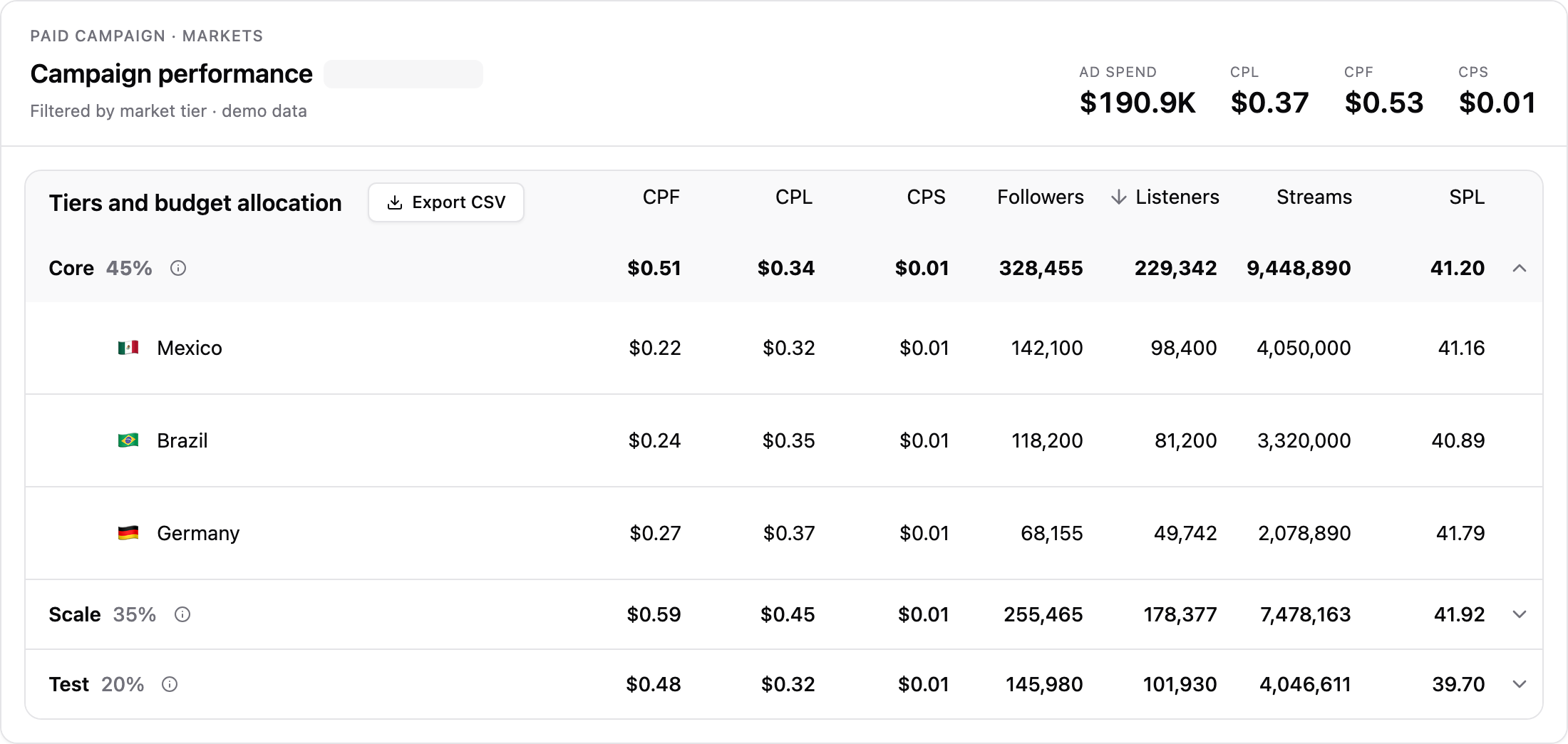
Soundlink’s published Meta campaign approach starts with three market groups:
-
40 percent for premium markets: United States, United Kingdom, Canada, Netherlands, Germany, and Belgium.
-
35 percent for growth markets: Mexico, Argentina, and Spain.
-
25 percent for scale markets: Brazil, the Philippines, South Africa, and selected Asian markets.
This is a starting structure, not a fixed rule. The right allocation changes with the artist’s language, genre, existing audience, and commercial plan.
An artist with tour dates in Germany should protect German spend. A Spanish language release may place more budget in Mexico, Argentina, Colombia, and Chile. An instrumental electronic release may give Southeast Asia a larger test.
The purpose of the tier structure is not to force every campaign into the same countries. It is to preserve enough budget in each group to learn what kind of listener the campaign is acquiring.
How Soundlink measures country performance after the click
Most Meta campaigns can show which country produced the cheapest click or landing page view. That is not enough for Spotify promotion.
Soundlink’s paid campaigns report Spotify side outcomes alongside ad spend. Teams can compare cost per listener, cost per follower, and cost per save rather than relying on landing page proxies.
This is particularly important for Tier 2 and Tier 3 targeting. A low cost market should earn more budget because it produces listeners who stream, save, follow, and return. It should not earn more budget only because Meta found cheap clicks there.
Soundlink also uses a tiered market structure for campaign delivery. Labels, managers, and artists can review the results and adjust the country mix to fit release goals.
Frequently Asked Questions
What are the best Tier 2 countries for Spotify promotion?
Soundlink’s published growth group includes Mexico, Argentina, Poland, and Chile. Spain also appears in Soundlink’s current mid tier campaign allocation. The best choice depends on language, genre, existing Spotify audience, and listener quality after the click.
What are the best Tier 3 countries for Spotify ads?
Soundlink’s published scale group includes Brazil, India, Indonesia, the Philippines, and Thailand. These markets can produce lower acquisition costs, but they should be tested separately and evaluated through Spotify outcomes.
Are Tier 3 Spotify streams low quality?
Country tier does not determine listener quality. Behavior does. A listener who completes the track, saves it, follows the artist, and returns is valuable evidence of audience fit in any market. A cheap one time play with no further engagement is weak in any market.
Does Spotify give emerging markets an algorithm boost?
Spotify has not confirmed a geography based boost. It confirms that recommendations use listening activity, playlist additions, similar listener behavior, and many other signals. Growth markets can help because lower acquisition costs create more opportunities to generate those signals.
Should Tier 1 and Tier 3 countries be in the same ad set?
Not when the goal is to compare market quality. Meta will usually direct more spend toward the countries producing the cheapest selected result. Separate ad sets preserve budget and reporting for each tier.
Is Latin America good for promoting English language music?
It can be. Electronic, pop, rock, alternative, and instrumental music often cross language boundaries. Test the creative with localized captions and use Spotify for Artists data to identify countries where the artist already has listeners.
Should an artist target the home market first?
Yes when the campaign supports touring, merchandise, local press, or community building. A mixed market strategy is often better when the goal includes both local career development and efficient Spotify growth.
Do cheaper markets generate lower Spotify royalties?
The effective revenue value of streams can vary by country and listener plan. Spotify does not use a fixed payment per stream. Artists should evaluate listener acquisition and royalty return as separate goals.
How should North African countries be tested?
Use separate country or language clusters. Match the creative to local language and genre context. Scale only after Spotify side data shows saves, follows, repeat listening, and catalog activity.
Country targeting is a portfolio decision
Premium markets offer touring relevance, higher commercial value, and local industry credibility. Growth and scale markets offer more listener volume for the same paid social budget.
Strong Spotify promotion uses both where the release goal supports it.
Tier 2 and Tier 3 countries are not shortcuts to empty stream counts. They are efficient audience markets when the campaign attracts relevant listeners and measures what happens after the click.
The country with the lowest CPR is not automatically the winner. The winner is the market that produces the strongest Spotify listener behavior at a cost the campaign can sustain.