


Why TikTok Views Do Not Turn Into Spotify Streams
TL;DR: A high TikTok view count does not reliably predict a Spotify stream. A view only confirms that a video reached someone. It does not confirm that the viewer opened Spotify, pressed play, or came back for more.
Industry estimates put the actual TikTok view to Spotify stream conversion rate at roughly 0.5 percent to 2 percent, depending on the artist and how clear the call to action is. Streams alone are also not the metric that matters most. The bigger question is whether those streams turn into retained Spotify listeners, the people who save, follow, and show up again for the next release. Closing that gap requires tracking TikTok driven exposure against actual Spotify listener behavior, not platform level view counts alone.
TikTok Has Solved Discovery. It Has Not Solved Attribution.
TikTok reports that its Add to Music App feature generated more than 6 billion track saves to premium streaming services between April 2025 and April 2026, across Spotify, Apple Music, Amazon Music, and other platforms (TikTok Newsroom). TikTok also says those saves led to many billions of additional streams through repeat listening.
Add to Music App matters because it turns a passive scroll into an explicit save action. A user who saves a track to Spotify has done something closer to demonstrating music demand than a user who simply watched a video play through.
But the feature does not make a TikTok view equivalent to a Spotify listener. TikTok highlights breakout examples, such as Sienna Spiro’s “Die On This Hill,” the most saved track globally through Add to Music App during the period TikTok reported. Examples like this show what happens when a TikTok moment breaks through at scale. They do not describe the more common case, where a video earns views, likes, comments, or sound usage, but few of those viewers ever open Spotify.
Smaller, more typical wins exist too. Playlist promotion service PlaylistPush has reported on an independent artist who grew from 2,000 to more than 32,000 monthly Spotify listeners through organic TikTok videos alone, with no ad spend behind them (PlaylistPush). That scale of result is a far more representative picture of what closing the gap actually looks like than a chart topping outlier.
A TikTok View Is Not Spotify Listener Intent
A TikTok viewer is usually engaging with a video, a joke, a creator, or a trend format. The song is often supporting the content rather than acting as the destination. A Spotify listener is making a different decision. They want to hear the song again, outside the context that introduced it to them.
This distinction shows up clearly when TikTok engagement metrics are compared to what they can actually prove about music demand.
| TikTok metric | What it likely means | What it does not prove |
|---|---|---|
| Views | The video reached people. | Demand for the full track. |
| Likes | The post resonated. | The viewer wants to stream the song. |
| Comments | The concept sparked a reaction. | The track will get repeat listens. |
| Shares | The content had social value. | The song will build Spotify followers. |
| Sound uses | Creators adopted the audio. | Listeners know or care about the artist. |
| Add to Music saves | A stronger intent signal. | A retained Spotify listener. |
A TikTok view tells you the video traveled. It does not tell you the song traveled with it.
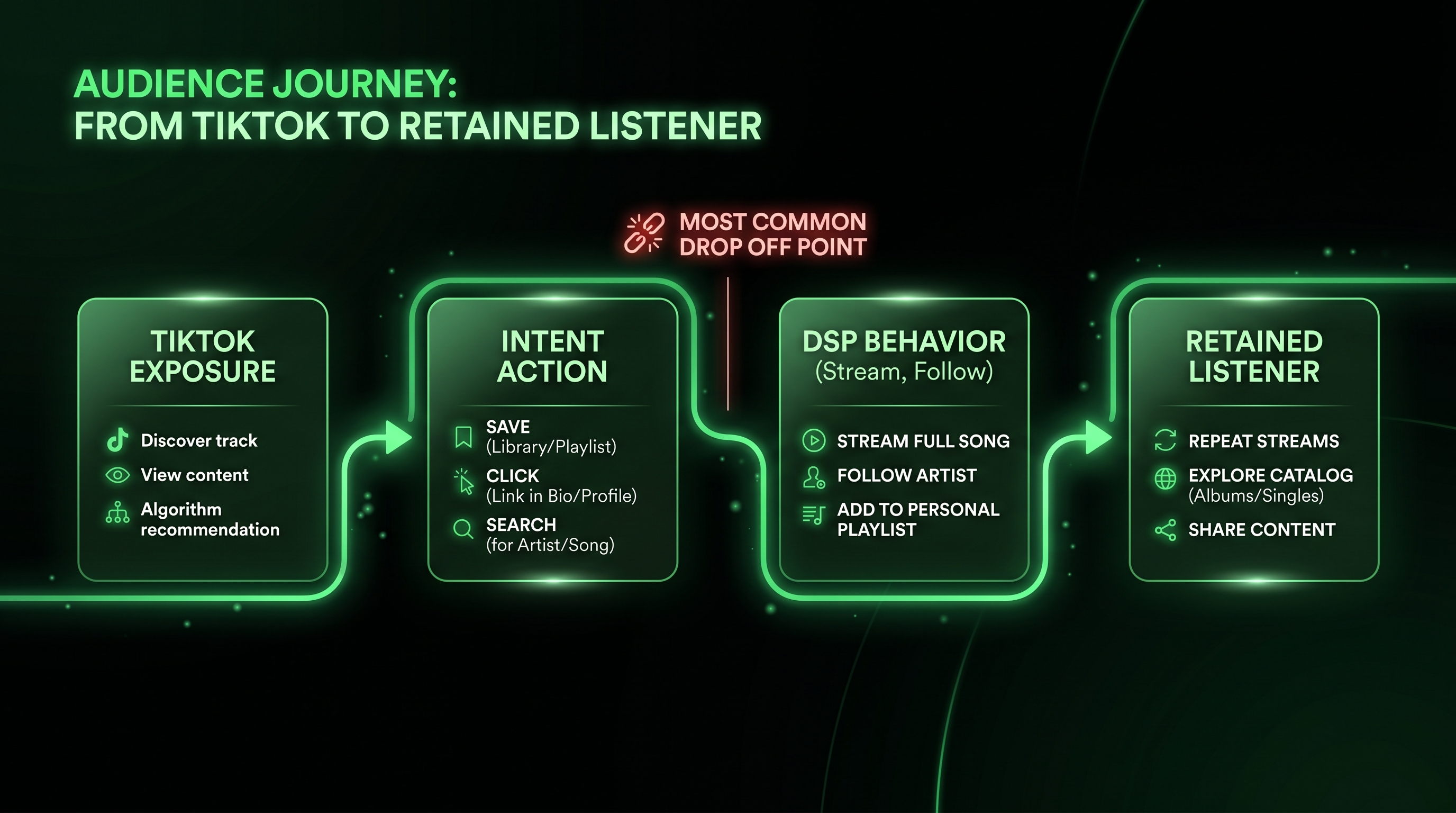
The more accurate model is not “TikTok views lead to Spotify listeners.” It is a longer chain: TikTok exposure leads to an intent action, which leads to DSP behavior, which leads to a retained listener.
Why the Handoff From TikTok to Spotify Breaks
TikTok Rewards Content Performance, Not Song Performance
A sound can perform well because the video idea works, not because the song does. The hook, the joke, the creator, or the trend format can carry the distribution on its own. This creates a measurement trap. High view counts and high sound usage can look like music momentum when they are actually content momentum that happens to use a song as background audio.
The DSP Handoff Is Still Fractured
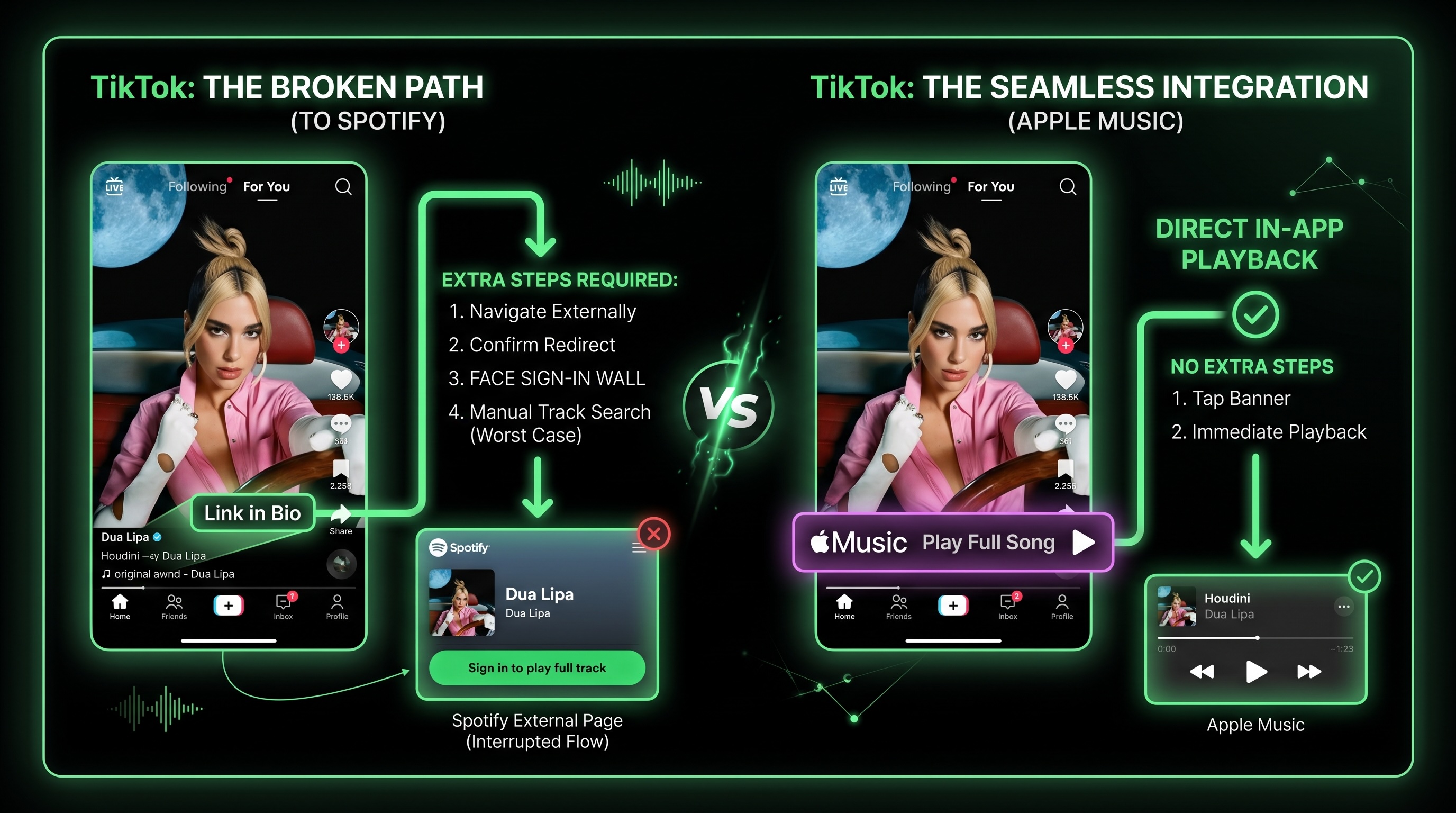
TikTok has reduced some of the friction between discovery and listening, but not evenly across platforms. TikTok and Apple Music launched Play Full Song in March 2026, letting Apple Music subscribers hear full length tracks inside TikTok through Apple Music’s MusicKit (TikTok Newsroom). TechCrunch reported that TikTok does not offer the same in app full song playback for other streaming services, including Spotify (TechCrunch).
For Spotify specifically, the path from a TikTok view to a stream still usually depends on a save, a profile click, a smart link, or the viewer remembering the song later and searching for it. Every added step is a chance for the viewer to drop off.
TikTok Discovery Is Not the Same as Spotify Algorithmic Fit
Spotify growth depends on downstream listener behavior. Repeat listens, saves, follows, playlist adds, low skip rates, and catalog exploration all feed Spotify’s own signals about a track and an artist. A song can have a strong hook that performs on TikTok while Spotify still has no evidence that listeners want the full track or the rest of the artist’s catalog.
SoundOn Is Expanding Into Post Discovery Label Services
The shift goes beyond a single product feature. Music Business Worldwide reported on June 1, 2026 that TikTok’s label services arm, SoundOn, is expanding its work with independent artists and labels in the United States, using Temper City’s “Self Aware” as the case study (Music Business Worldwide).
According to that report, “Self Aware” entered the Billboard Hot 100 and the UK Top 40, reached number one on Spotify’s Global Viral chart, hit number 22 on the Spotify Global Top 50, passed 150 million Spotify streams, and soundtracked more than 6.4 million TikTok videos that generated over 11 billion views.
SoundOn frames its role as more than viral support. Music Business Worldwide also reported that SoundOn provided distribution, platform insights, marketing strategy, and artist development around the release, with planned tools covering accounting, royalty management, financial workflows, sub label management, and early access to Spotify Discovery Mode from an artist’s first release.
The point is not only that one track went viral. TikTok is positioning itself to own a larger share of the post discovery workflow that has historically belonged to labels, distributors, and marketing teams, not just the discovery moment itself.
The Real Tension: TikTok Impact vs Spotify Ownership
Two things are both true here.
TikTok and Luminate reported that TikTok users are more likely than the general US population to pay for a music streaming subscription, that artists with strong TikTok correlation showed faster week over week streaming growth in their analysis, and that a sizable share of tracks entering the Billboard Global 200 had already gone viral on TikTok (TikTok Newsroom).
At the same time, TikTok exposure still does not guarantee Spotify audience growth. Views accumulate inside TikTok, while the actual artist relationship, saves, follows, streams, and algorithmic signal, needs to move to Spotify to count for anything.
Music Business Worldwide has argued separately that the music business has a customer ownership problem: artists and rights holders help build audiences on platforms that monetize the attention, without fully owning the listener relationship that attention creates (Music Business Worldwide).
TikTok creates the discovery moment. Spotify captures the long term listener value. Most labels and artists currently own neither the platform attention nor the resulting listener relationship in full.
Where the Funnel Actually Breaks
This contradiction shows up at ground level too. A recent r/musicmarketing thread captures the confusion well: artists describe traction on TikTok or YouTube while Spotify monthly listeners stay flat, and the replies recommend a mix of direct links, Meta ads, TikTok ads, playlisting, and link in bio cleanup, often contradicting each other (Reddit).
That lack of a settled playbook is itself a signal. Most cases fall into one of a few diagnostic categories.
| Symptom | Likely issue | Recommended fix |
|---|---|---|
| High TikTok views, low Spotify streams | The content is carrying the song, not the other way around. | Test song first creative and a clearer save or listen call to action. |
| High sound uses, low artist follows | The trend is detached from artist identity. | Add artist branding and a recurring identity signal across videos. |
| High clicks, low Spotify listeners | Friction on the landing page or DSP handoff. | Test direct to DSP links against smart links and remove steps. |
| High streams, low repeat listens | Wrong audience match or weak full track fit. | Improve creative to audience matching and track streams per listener. |
| High TikTok engagement, no saves | Weak intent capture. | Push Add to Music save behavior and retarget engaged viewers where possible. |
| Spotify listeners but no followers | Weak profile or shallow catalog depth. | Improve the artist profile, Canvas, Artist Pick, pinned release, and catalog pathways. |
What Artists and Labels Are Testing to Close the Gap
The funnel breaks for a handful of recurring reasons, and a similar set of fixes keeps showing up across music marketing forums, artist manager interviews, and promotion guides. None of these guarantee a result. They reduce friction at specific points in the chain described above.
Fix the Landing Spot Before Sending Traffic
A bare Spotify profile with one song and no context is the easiest way to lose a viewer who already clicked through. Spotify’s own artist resources point teams toward Canvas loops, a pinned release, Artist Pick, and sponsored placements like Marquee and Showcase as ways to give a new visitor a reason to stay once they land (Spotify). Marquee and Showcase require Spotify for Artists access in supported markets, so they are not available to every account. Some promotion guides cite Spotify data showing a measurable lift in stream through rate for tracks using Canvas, though the exact figure varies by source and is worth treating as directional rather than fixed.
Replace Raw Profile Links With Smart Links
Several independent guides describe the same funnel for a TikTok viewer: view, profile visit, link click, Spotify open, stream, follow, with friction compounding at every step (Orphiq). A raw Spotify URL only works for the share of an audience already on Spotify. A smart link detects the visitor’s platform and routes Apple Music or Amazon Music users to the right destination instead of losing them outright. The same source estimates TikTok view to Spotify stream conversion typically lands between 0.5 percent and 2 percent, a self reported figure that is not independently verified, but consistent with the order of magnitude cited across several similar guides.
Use Pre Save Mechanics, Including TikTok’s Native Test
Pre save campaigns are reported to convert at meaningfully higher rates than a basic link in bio. One promotion company’s aggregated campaign data lists email and direct message channels as the strongest converters, with TikTok and other social platforms converting lowest, around 1 percent to 3 percent, but at higher volume (Chartlex). These are vendor reported figures from a single promotion company, not industry wide data, so they should be read as a directional benchmark rather than a guarantee.
Separately, one report from February 2026 describes TikTok testing a native pre save function that would let fans save an upcoming release directly inside a TikTok video before it goes live, extending the existing Add to Music App model to unreleased tracks (dig dis). As of this writing the feature is described as being tested rather than broadly available.
Separate Channel Promotion From Sound Promotion
Artist managers interviewed by Hypebot in April 2026 draw a distinction that matters here. Channel promotion is about the artist’s own brand. Sound promotion is about a piece of audio fitting a trend or meme, which can happen with no connection to the artist at all, and only a portion of the people using that sound ever follow it back to the artist on Spotify (Hypebot).
A sound can go viral with no relationship to the artist behind it. Spotify conversion depends on closing the gap between the sound and the artist, not just the sound and the trend.
The practical version of this advice shows up across multiple creator and artist guides: lead TikTok clips with the song’s most distinct or emotionally charged segment instead of the intro, repost or duet fan generated content that uses the sound, and use captions and on screen text to reinforce who made the song rather than relying on the sound credit alone.
The Gap Shows Up in Real Artist Numbers, Not Just Aggregate Data
The disconnect described throughout this article is not abstract. The BBC reported on Welsh artists managing it directly: one had more than 12,000 social media followers but only a few hundred monthly Spotify listeners, and another had 57,000 social followers but had released only a single song to Spotify at the time of reporting (BBC, via AOL). Both described the same pattern covered above, strong attention on short form video, weak carryover to a platform where a listen actually counts as a stream.
None of the tactics above replace measurement. They tighten the funnel, but a label or artist still needs a way to see whether a tighter funnel is actually converting better than the last one.
A Better Metric Framework for TikTok Driven Spotify Growth
Tracking views, likes, and shares answers what happened on TikTok. It does not answer what happened on Spotify. A more complete framework pairs both sides.
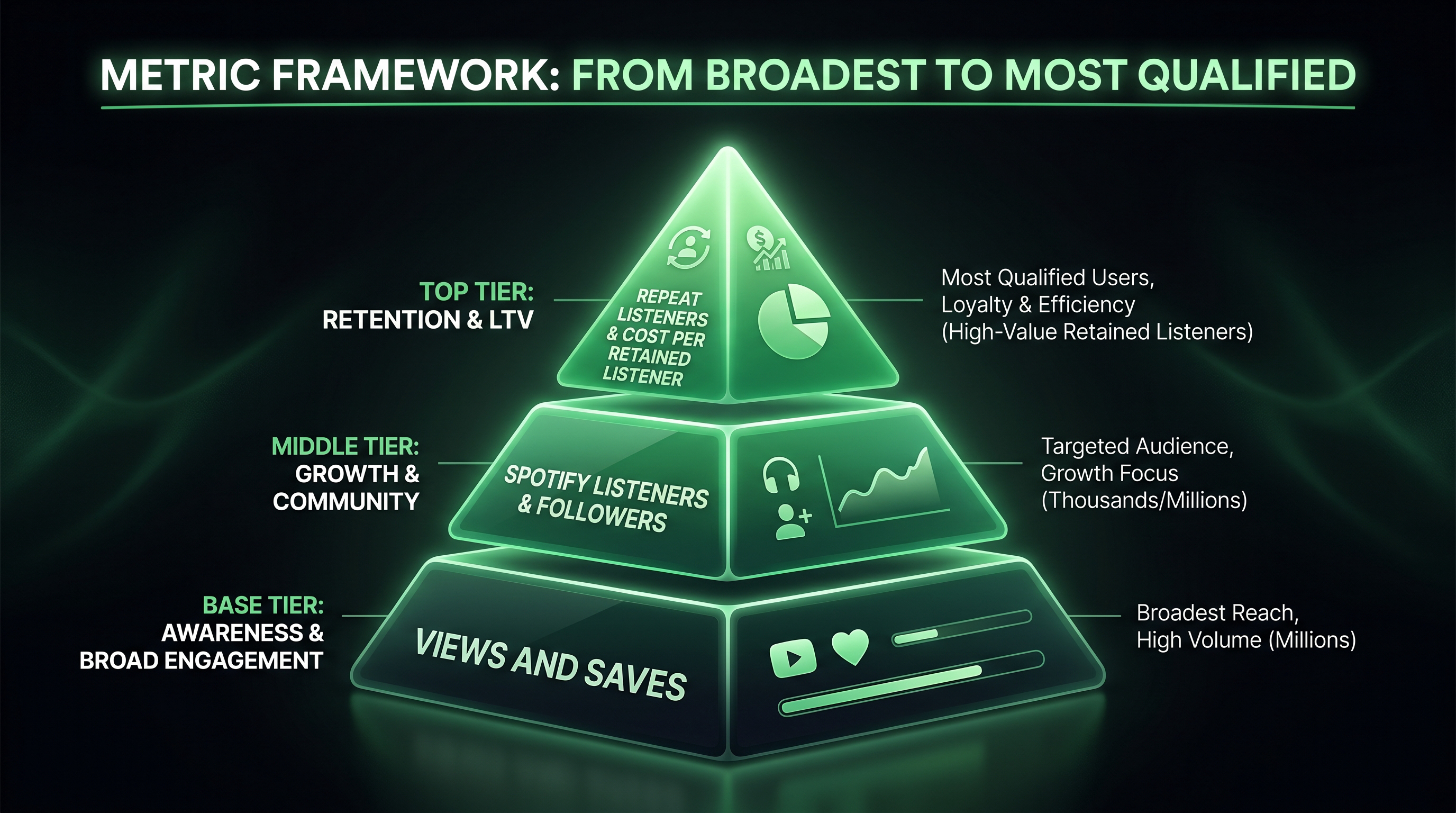
Add to Music saves: the strongest intent signal available directly inside TikTok, stronger than a view but still short of a confirmed Spotify listener.
Spotify listeners: the baseline measure of whether TikTok exposure actually produced a Spotify audience.
Spotify followers: a signal that the listener wants ongoing access to the artist, not just the one track.
Saves per listener and streams per listener: ratios that show whether the audience TikTok sent over is actually engaging once they arrive.
Repeat listeners: the clearest evidence that a track is building real fans rather than one time curiosity streams.
Active audience: listeners who keep returning across releases, not just the one viral moment.
Cost per retained listener: for any paid TikTok or Meta activity behind the content, the metric that ties spend back to listeners who actually stuck around.
Frequently Asked Questions
Does TikTok actually drive Spotify streams?
Yes. TikTok and Luminate have reported that TikTok correlated artists see stronger streaming growth and that a large share of tracks entering major streaming charts had a prior TikTok moment. The effect is real at the aggregate level, but it is not guaranteed for any individual song or artist.
Why do TikTok views not show up as Spotify listeners?
A TikTok view only confirms that a video was watched. It does not confirm that the viewer wants the song outside of TikTok. Spotify listener growth requires an additional intent action, such as a save, a profile click, or a search, and most viewers never take that step.
What is TikTok’s Add to Music App feature?
Add to Music App lets TikTok users save a song they discover in a video directly to a connected streaming service, including Spotify, Apple Music, and Amazon Music. TikTok reports the feature has generated billions of saves, a stronger intent signal than a view but still not the same as a retained listener.
Can Spotify listeners hear full songs inside TikTok the way Apple Music users can?
No. TikTok and Apple Music launched Play Full Song in March 2026, letting Apple Music subscribers hear full length tracks inside TikTok. TikTok has not extended the same in app full song playback to Spotify, so the path from a TikTok view to a Spotify stream still depends on the viewer leaving the app.
How can an artist or label tell if a TikTok campaign actually converted to Spotify listeners?
The only reliable way is to track TikTok driven traffic against actual Spotify outcomes, such as listeners, followers, saves, and repeat streams, rather than relying on TikTok view counts or click totals alone.
What is a good TikTok view to Spotify stream conversion rate?
Industry estimates from independent promotion guides put typical conversion somewhere between 0.5 percent and 2 percent of views, meaning 100,000 views might produce 500 to 2,000 Spotify streams. These are self reported industry estimates, not data published by TikTok or Spotify, so they should be treated as a general sense of scale rather than a fixed benchmark.
Can I run TikTok ads to grow Spotify streams the same way I run Meta ads?
Yes. The attribution architecture is the same regardless of which platform serves the ad. The harder problem is connecting either platform’s click and view data back to actual Spotify outcomes. Soundlink’s guide to Spotify attribution from Meta ads breaks down that measurement gap in detail, and it applies equally to TikTok ad spend.
Measuring Whether TikTok Activity Becomes Spotify Behavior
The thesis above holds whether the TikTok activity is organic or paid. TikTok’s own Promote tool can turn an organic post into a paid ad with a few taps, and it is a reasonable way to push a video that is already working. It still reports the same shallow metrics as an organic post, views, likes, and clicks, not what happened on Spotify afterward. Running paid social through Meta carries the identical reporting gap, covered in full in Soundlink’s guide to tracking Spotify streams from Meta ads. Ad platforms report cost per click and cost per view. They do not report what happened on Spotify afterward.
Soundlink’s paid campaigns close that gap for Meta and TikTok ad spend tied to a Spotify track or playlist, reporting cost per listener, cost per follower, cost per save, and attributed streams alongside ad spend, using Spotify side measurement that goes beyond landing page proxies.
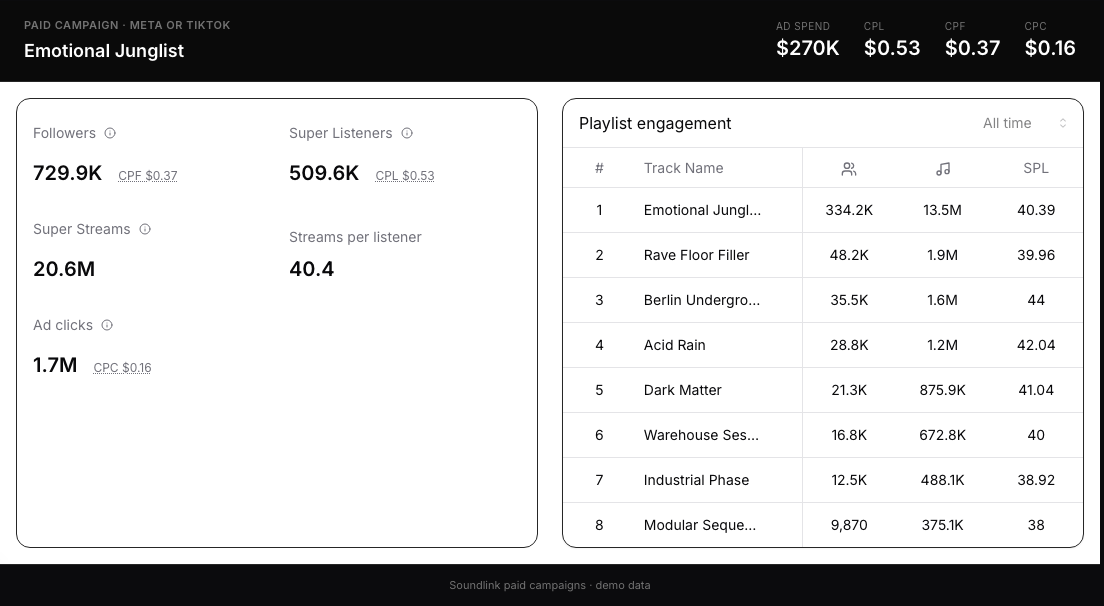
TikTok can keep proving it drives discovery at scale. The open question for labels and artists is whether those discovery moments turn into Spotify listeners they actually keep.