
The videos that won were more expensive to show.
We set out to give Do It For Me campaigns a much wider range of ad videos, as long as performance held up. In our Electronic music tests, every thousand ad impressions on the new mix cost about 24% more, and fewer people saw the ads. On paper, that looks like a worse campaign.
It was a better one. Cost per listener fell 32%. Cost per stream fell 38%. Listeners were more likely to come back and play the track again.
This post explains what we changed in Soundlink’s Do It For Me campaigns, how we tested it, what the numbers showed, and what you will notice in your own campaigns.
TL;DR: Do It For Me campaigns in Electronic music now choose ad videos from a much wider pool, weighted toward what is already performing for similar campaigns, instead of rotating only a fixed curated pack. The goal was more variety with performance at least as good as before. Performance improved: ads earned 23% more clicks per impression, cost per listener dropped 32%, and cost per stream dropped 38%. Listener quality held steady or improved. The change applies to Electronic Do It For Me campaigns first. Other genres follow once each one passes the same test.
New to Soundlink? A Quick Primer
Soundlink runs Meta ad campaigns for labels, management and marketing teams and reports results in Spotify terms: listeners, streams, followers, and what each one costs. Most ad tools stop at clicks. Soundlink measures what happens after the click.
When you create a campaign, you choose a creative direction:
- Do It For Me (DIFM): Soundlink makes short vertical ad videos for you, based on your genre and sound. You pick the track, campaign strategy, set a budget, and the campaign runs.
- Full control: you upload your own videos, pick a strategy or target markets, and Soundlink runs the campaign around them.
Most of our customers use Do It For Me. It is the fastest way to get a release in front of new listeners without producing ad creative yourself. That also makes video selection one of the biggest levers we control on your behalf.
What Changed: From a Fixed Pack to a Performance Mix
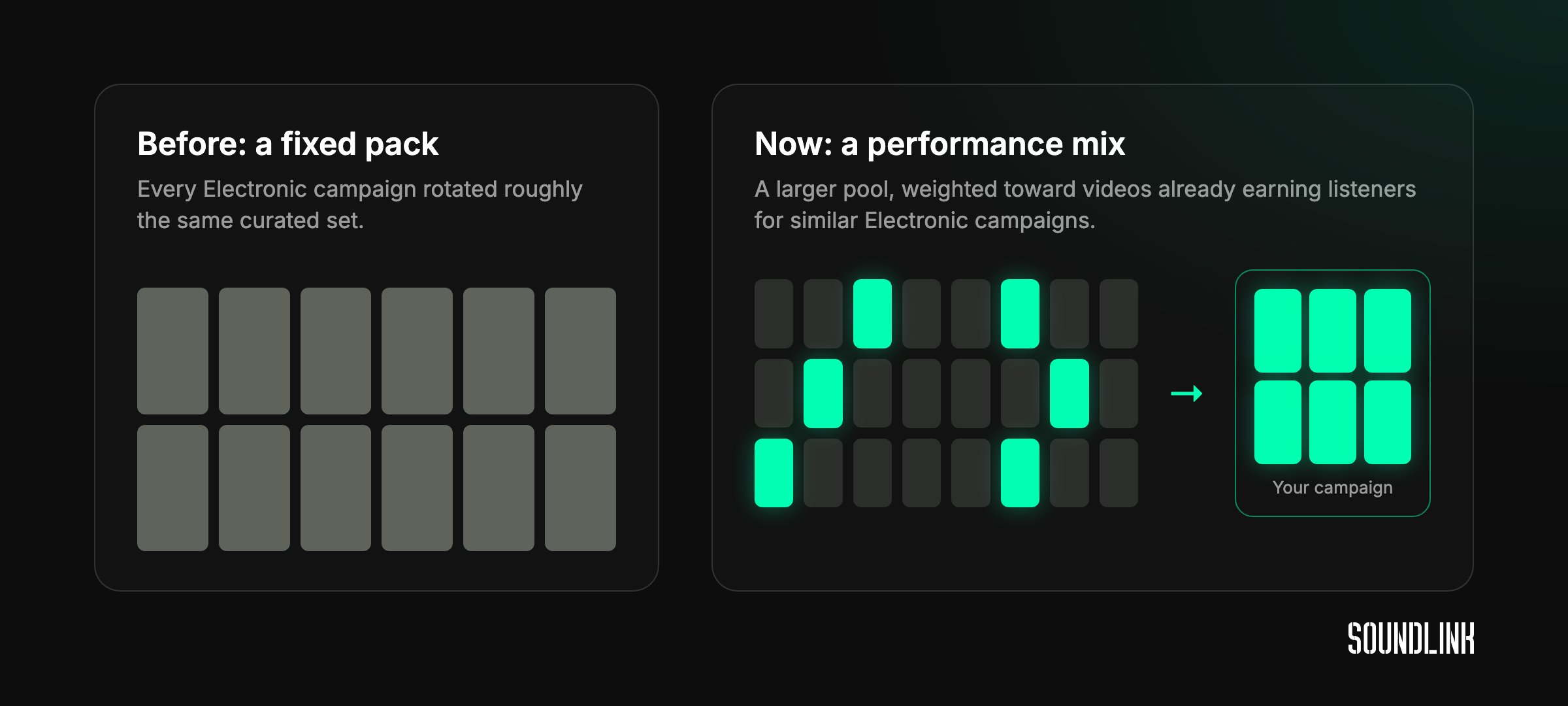
Until now, every Electronic DIFM campaign drew from a curated pack of videos. The pack was well chosen. Each video in it had been used in campaigns before. But the pack was fixed. Every campaign rotated through roughly the same set.
We wanted each campaign to draw from a much wider range of videos. The new approach builds each campaign’s video mix from a much larger pool of Electronic videos, and it prioritizes the ones that are already earning listeners for similar Electronic campaigns. Videos with a track record of turning ad viewers into listeners get more weight.
Nothing else about the campaign changes. Same targeting. Same budget. Same Do It For Me flow. The only difference is which videos your ads use.
How We Tested It
We ran the new mix against the previous pack on live Electronic DIFM campaigns, with two layers of checks.
Side by side campaigns: new Electronic DIFM campaigns were assigned to either the previous pack or the new performance mix. Both groups used identical audience settings, placements, and budget ranges. We compared cost per listener, cost per stream, click through rate, and listener quality.
Matched pairs: we then cloned two Electronic tracks into identical campaigns, one on each approach, with the same budget and the same start date. That removes almost every variable except the videos. If the result held up here, it was the videos doing the work.
The bar for shipping was set before the test started. The wider mix had to match or beat the previous pack on cost per listener and cost per stream, with no drop in listener quality. Matching the pack would have been enough to ship. Anything better was a bonus.
The Results
The wider mix did more than match the previous pack. Compared to the fixed pack, across Electronic DIFM test campaigns:
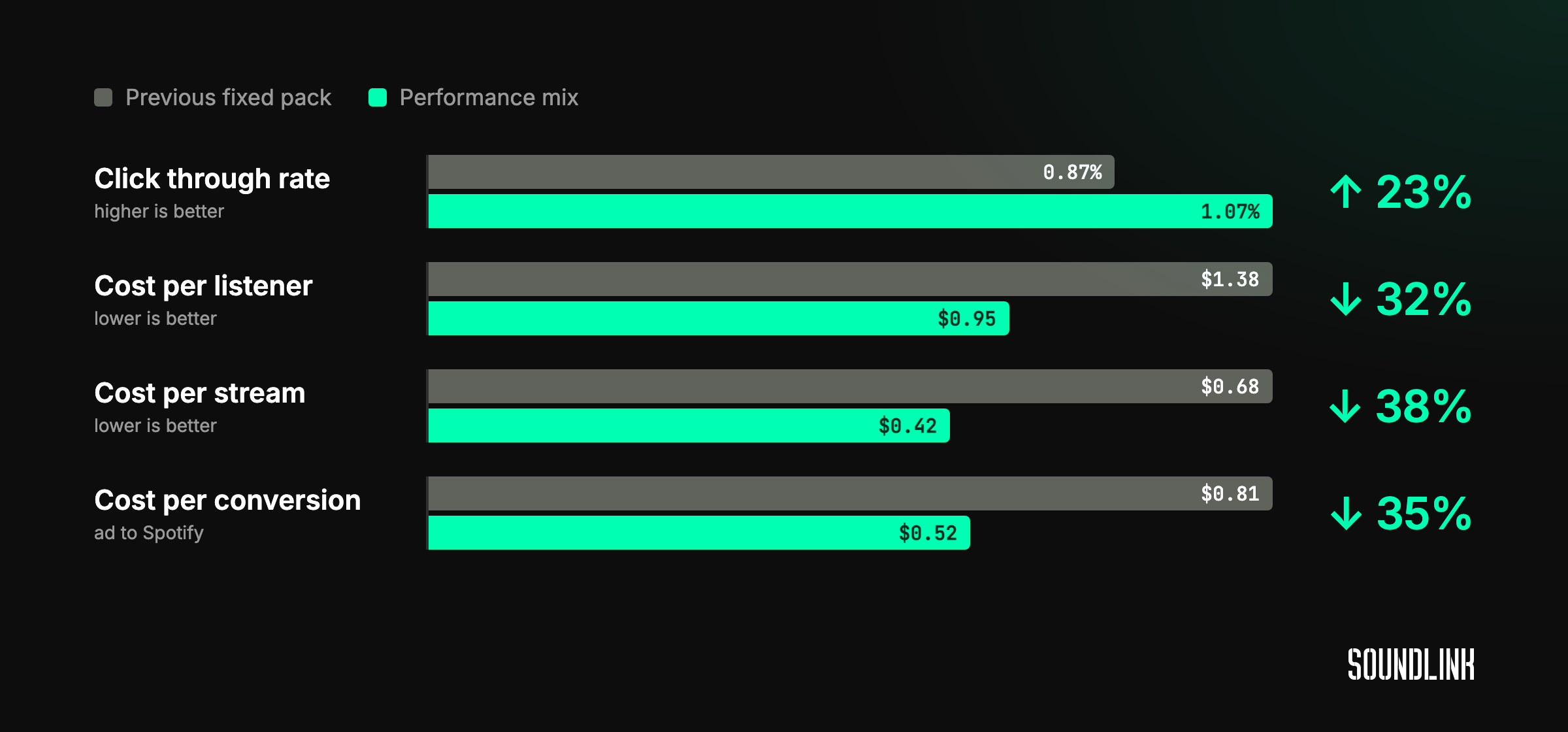
| Metric | Previous pack | Performance mix | Change |
|---|---|---|---|
| Click through rate | 0.87% | 1.07% | 23% higher |
| Cost per listener | $1.38 | $0.95 | 32% lower |
| Cost per stream | $0.68 | $0.42 | 38% lower |
| Cost per conversion from the ad | $0.81 | $0.52 | 35% lower |
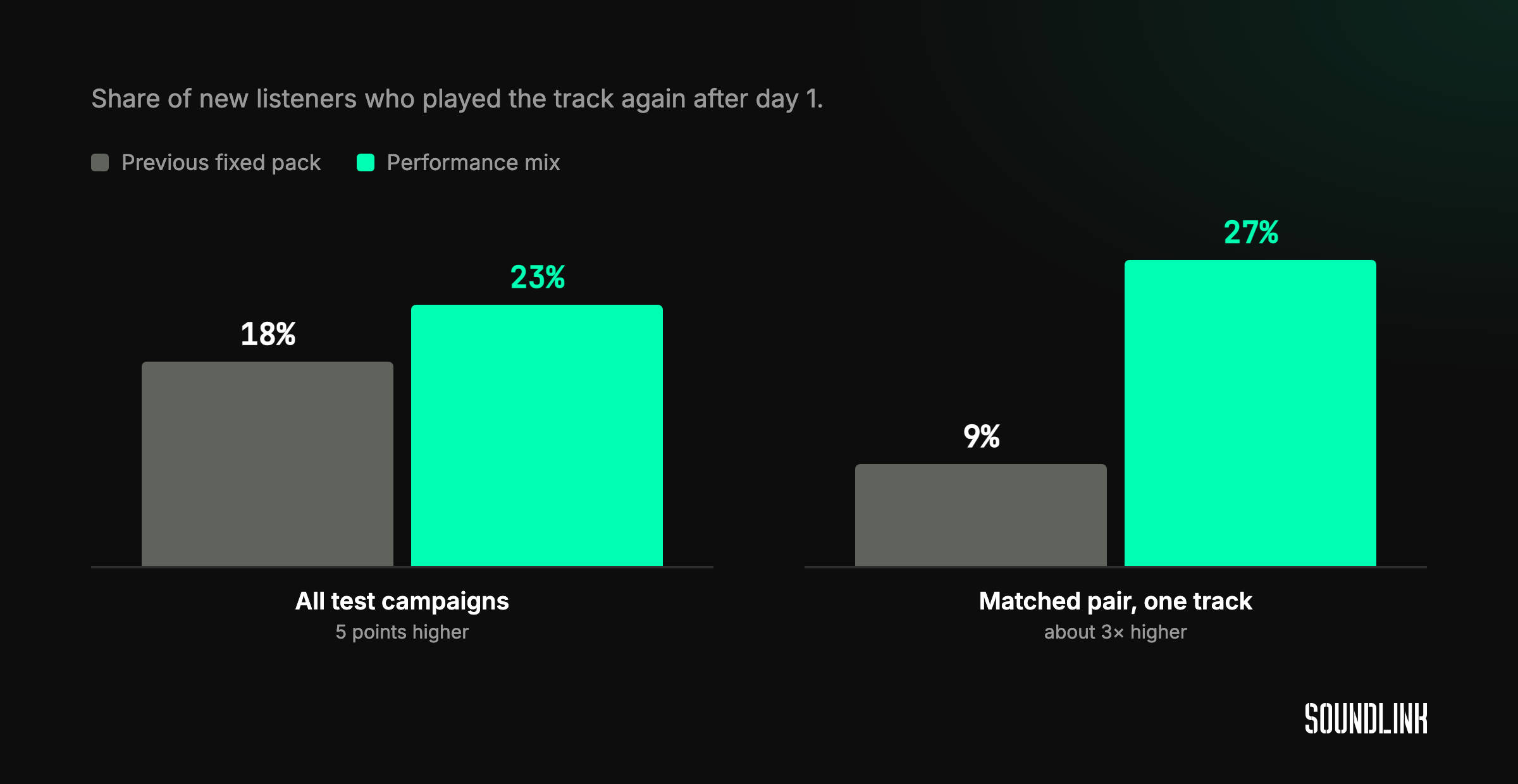
| Listeners who came back after day 1 | 18% | 23% | 5 points higher |
The performance mix group also delivered 69% more listeners and 86% more streams in total. It spent about 16% more over the test window, so the volume gain is larger than the spend difference explains, but the cost figures above are the cleaner comparison.
Cost per conversion here means the cost to get someone from the ad onto Spotify. It is the step between a click and a stream.
Cost per listener dropped 32% and cost per stream dropped 38%, with no change to targeting or budget.
The matched pairs pointed the same way. Across both tracks, cost per conversion was 26% to 34% lower on the performance mix and cost per stream was 19% to 26% lower, depending on the track.
Why Fewer Impressions Produced More Listeners
This is the part that surprised us, and it is the part you are most likely to notice in your reporting.
The performance mix videos got more clicks per impression. Meta responds to that by showing the ad to people more likely to click. Those people cost more to reach, so each impression gets more expensive and the same budget buys fewer of them.
On one of the matched pairs, the campaign on the performance mix:
- reached 38% fewer impressions on the same budget
- earned more than double the click through rate (0.65% to 1.43%)
- converted at a 26% lower cost from ad to Spotify
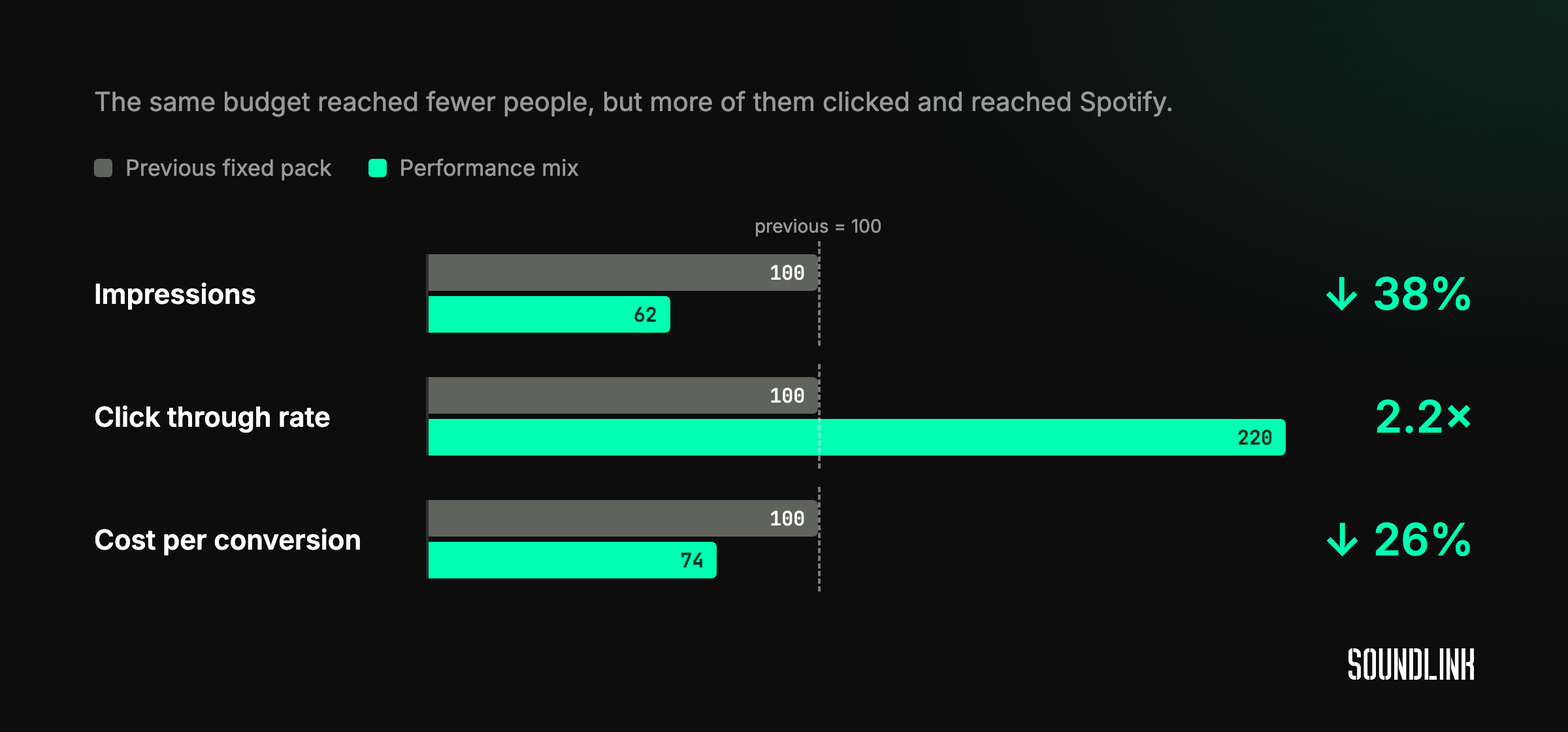
Impressions and reach are inputs. Listeners and streams are the output. A campaign that shows the ad to fewer, better matched people is doing its job, even when the top of the report looks smaller.
A smaller impression count with a lower cost per listener is the performance mix working, not a campaign underdelivering.
Listener Quality Held Up
Cheaper listeners are only useful if they are real listeners. We tracked two quality signals throughout the test.
Return listening: the share of new listeners who played the track again on a later day. On the performance mix, this rose from 18% to 23%. On one of the matched pairs, it rose from 9% to 27%.
Streams per listener: essentially flat (1.56 on the previous pack, 1.58 on the performance mix). The new mix did not trade depth for volume.
One number dipped slightly. Of the people who reached Spotify from the ad, 55% went on to stream the track, compared to 59% on the previous pack. Because far more people reached Spotify for the same budget, the campaigns still ended up with more streams at a lower cost per stream. We will keep watching this number as the mix scales.
What This Means for Your Campaigns
If you run Electronic music campaigns with Do It For Me, the performance mix applies automatically. There is nothing to switch on.
What you can expect to see:
- Lower cost per listener and cost per stream on average, in line with the test results above
- Higher click through rate on your ads
- Fewer impressions and less reach for the same budget, for the reasons explained above
- More variety in the videos your campaign uses, with more weight on the styles that are performing for Electronic campaigns right now
What does not change:
- Your targeting, budget, and campaign setup
- How results are reported in Soundlink
- Full control campaigns, which keep using the videos you upload
These are test averages, not a guarantee for every campaign. Results vary by track, budget, and timing. The direction was consistent across the test campaigns and both matched pairs.
Why Electronic First, and What Decides the Next Genre
We tested in Electronic music because it has a high volume of DIFM campaigns and a deep pool of videos to choose from. That gave us enough data to make a clear call.
It also means the result is proven for Electronic music and not yet for anything else. The styles that performed best in Electronic campaigns may not be the ones that perform for hip hop, pop, or indie. Shipping the change to every genre on the strength of one genre’s data would be a guess.
So every genre goes through the same process before it moves to the performance mix.
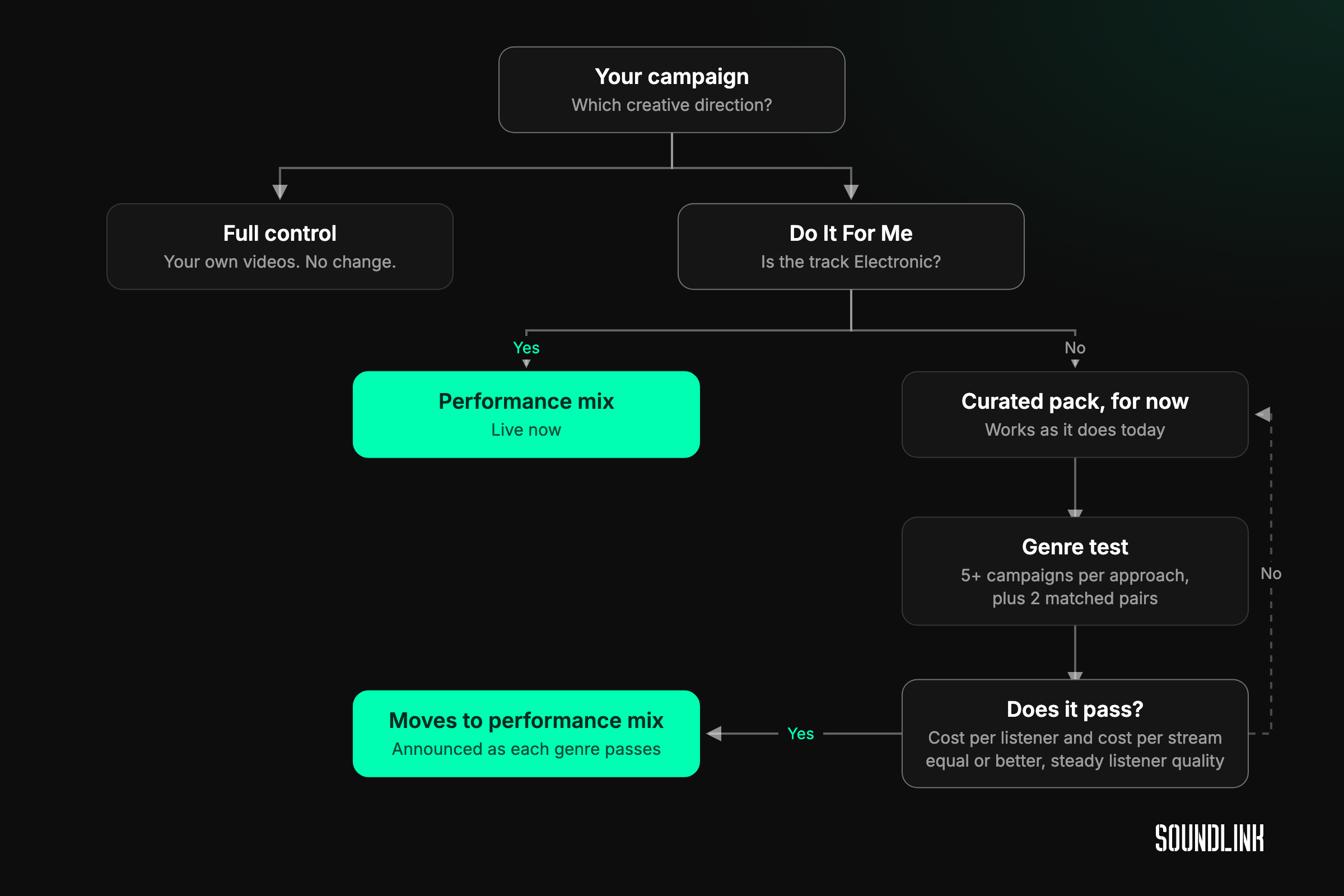
Each genre needs at least five campaigns on each approach plus two matched side by side tests. It moves over when cost per listener and cost per stream are equal to or better than the curated pack, with no drop in listener quality. Until then, campaigns in that genre keep using the curated pack, which continues to work as it did.
We will share results as each genre clears the bar.
Frequently Asked Questions
Do I need to change anything in my campaigns?
No. Electronic Do It For Me campaigns use the performance mix automatically. Your targeting, budget, and setup stay the same.
Which campaigns does this apply to?
Do It For Me campaigns for Electronic music tracks, at any budget. Full control campaigns are not affected. Other genres move over once they pass the same test.
Why did my impressions go down?
The performance mix favors videos that earn more clicks. Meta shows those ads to people more likely to click, who cost more to reach. You get fewer impressions for the same budget, but more of them turn into listeners and streams. Judge the campaign on cost per listener and cost per stream, not on reach.
Will every campaign see a 32% lower cost per listener?
No. The figures are averages across the test campaigns. Individual results depend on the track, the budget, and timing. The improvement was consistent in direction across the test, not identical in size.
Are the new videos made specifically for my track?
Do It For Me videos are matched to your genre and sound, as before. What changed is how many videos your campaign can draw from, and which ones it leans on. Selection now favors the ones already performing for similar Electronic campaigns.
When will my genre get the performance mix?
When it passes the same test Electronic did: cost per listener and cost per stream equal to or better than the curated pack, with steady listener quality. We will announce each genre as it moves over.